
Units
Best Rush Royale Units for Beginners: A Starter Core That Scales
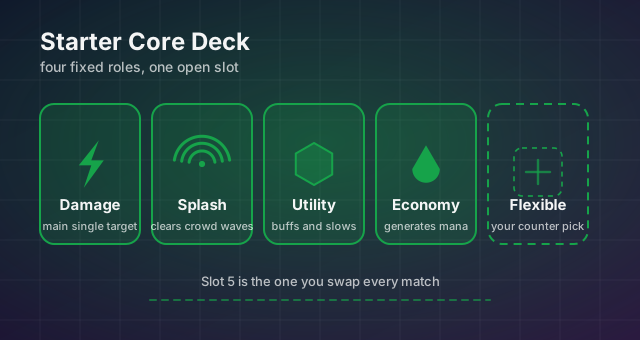
Key takeaways
- Pick your core five by slot role, not by whichever unit looks strongest in isolation.
- A thin collection cannot fund a ladder deck — deep upgrades on few cards beat unlevelled variety.
- One flexible experimental slot keeps your deck adaptable without diluting your upgrades.
Beginners usually ask which units to bring, but names change with every balance pass while the jobs never do. This guide gives you a five-slot starter core described entirely by function - steady damage, economy, utility, wave clear and one rotating experiment slot - plus a screening table you can apply to any card already in your collection. If you are still deciding how to get the game running smoothly, install and update only through Google Play, the App Store or the official site, and treat any unofficial modified installer offered elsewhere as a fast way to lose the account.
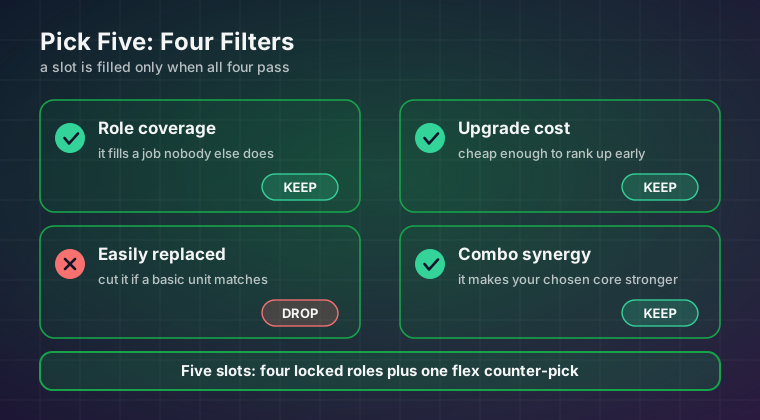
Learn the five jobs before you learn any card name
A Rush Royale deck is five cards, which means each slot is twenty percent of your entire plan. Deciding by job keeps the deck functional after a patch moves things around, because you replace "my heavy single-target unit" with whatever card currently fills that role instead of mourning a nerf.
Each match draws units from those same five cards and you raise them by merging identical units of the same level. Units you rarely draw are units you rarely rank up, so popularity and rarity matter far less than how often a card realistically reaches a meaningful rank inside one run.
Price your deck by draw frequency, not by ceiling: a unit that only shines at maximum rank is a liability if your early mana cannot reach it before the first boss.
The five slots of a starter core
The starter core is deliberately boring. It trades peak power for consistency, and consistency is what actually moves you through the leagues while you are still learning wave timing and placement.
Slot 1: the reliable damage dealer
This is a single-target damage dealer that works acceptably even at low rank. It kills bosses and anything else with a large health pool. The test is simple: does it still contribute when it is only rank two or three? If it needs maximum investment to matter, it goes in slot five, not slot one.
Slot 2: the economy unit
Your mana-generating support unit. It never tops the damage meter but it decides how much board you can build. New players chronically under-invest here and then wonder why their board stalls at three units in every wave between betting rounds.
Slot 3: the utility unit
A slow / debuff unit buys reaction time. Slows soften both dense waves and boss pushes, and they forgive imperfect placement better than raw damage does. This is the cheapest source of survivability available to a beginner.
Slot 4: the wave-clear unit
A splash-damage unit handles volume. Without it, packs of small enemies leak past your dealer while it is still chewing a single target, and leaks compound across a run.
Slot 5: the rotating experiment slot
One slot is deliberately unstable. Use it to test whether a second damage dealer, a summon-style unit, or something experimental improves your results. Because everything else is fixed, any change in performance can be attributed to this one card.
Screening criteria: does this card deserve a slot?
Run every candidate through the table below before it touches your deck. Three failed checks is a bench card no matter how strong it looks in isolation.
| Requirement | Pass condition | Automatic red flag |
|---|---|---|
| Merge reachability | Cheap or common enough to rank up most matches | Only playable at maximum rank |
| Job clarity | You can name its job in one sentence | Duplicates a job already covered |
| Low-rank floor | Contributes before heavy investment | Useless until fully merged |
| Independence | Functions without a specific partner card | Requires two other cards to work |
| Board fit | Has a natural tile position on most boards | Needs an exact formation you rarely get |
| Economy cost | Placement cost fits your opening curve | Too expensive to place in wave one |
Keep list for the experiment slot, applied one change at a time:
- Write down the five cards and the job each one covers before the session starts.
- Change exactly one card, then play five to ten matches before judging.
- Record the wave where each run ended, not just win or lose.
- Remove a card only when symptoms point at it - bosses surviving means damage, empty mana means economy, leaked packs means splash.
- Revert immediately if your average clear depth drops across the sample.
Why you should not copy high-league decks on day one
Top decks are built for players who already have deep collections, upgraded cards and the mechanics to execute a tight opening. Importing one gives you a weaker version of that deck: lower card levels, missing substitutions, and a curve you cannot fund. The result loses to decks half as clever.
Those lists are also tuned for one point in the season meta and often lean on a ramp unit with weak first waves, survivable only because the pilot knows exactly how long they can hold back.
Finally, copying removes the feedback loop: losing with a borrowed list teaches you nothing about which job failed, while losing with a job-built core points straight at the fix. Borrow archetypes, build the cards yourself.
What "scales" means for a beginner core
A core scales when each addition makes the existing four better rather than competing with them. Adding a second dealer usually does not scale, because both fight for the same limited mana. Adding economy scales, because it raises the mana pool every other card draws from.
Damage drawn from a broad pool of cheap, mergeable units keeps working whatever your card levels are, whereas a single expensive payoff unit depends entirely on upgrades you may not have yet.
Final verdict
A beginner core is defined by roles, not personalities: one dependable dealer, one mana engine, one control piece, one splash unit and one slot you are allowed to experiment with. That shape survives balance changes, card levels and mode switches because nothing in it depends on one specific unit staying strong.
Apply the screening table before every swap, change one card per day, and judge by how deep you clear rather than by single results. Players who do this stop guessing within a week and start cutting cards for reasons they can actually explain.
Keep reading
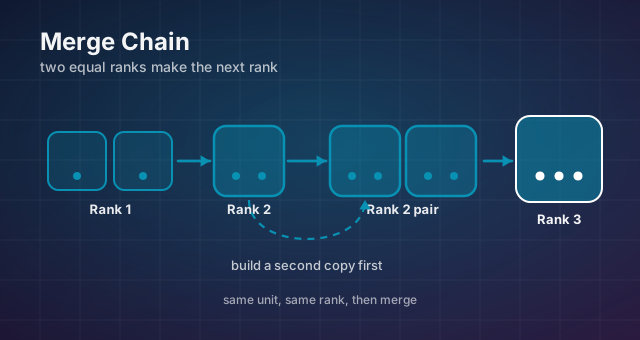
Rush Royale Merge Mechanics: Every Rule Behind Ranking Up Units
Rank thresholds, why empty board tiles are a resource, when to merge and when to hold, and the misplays that quietly cost you a run.
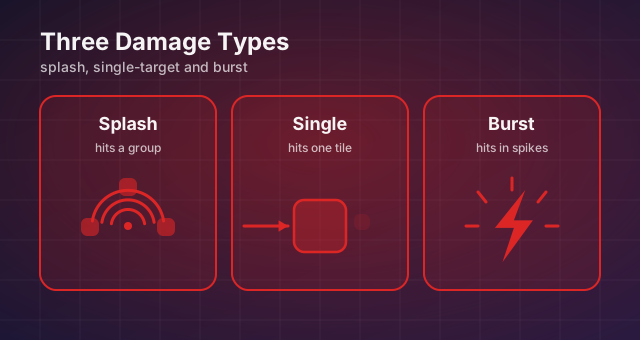
Rush Royale Damage Types Explained: Splash, Single-Target and Burst
The three damage profiles in Rush Royale, what each one answers, and why a single-target-only deck gets overrun by dense waves.
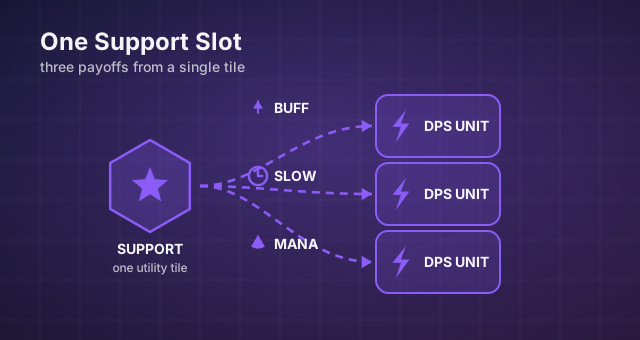
Rush Royale Support and Utility Units: Buffs, Slows and Mana Generation
Why the utility slot is the most underrated tile on your board — and the point where cutting it for raw damage actually makes sense.