
Version updates
Rush Royale Update Explained: How to Read a Patch and Rebuild Your Deck
Key takeaways
- Balance patches usually shift which cards deserve your gold, not which archetypes are viable.
- Read patch notes for changes to mana and board economy first — damage numbers are the noisy part.
- Hold resource spending for a day after a patch so you can see how the meta actually settles.
Every Rush Royale update arrives with a wall of patch notes: balance tweaks, new units, talent changes and a long list of fixes. The notes tell you what changed, but they rarely tell you what it means for the five-card deck you actually play. This is a reusable template for reading Rush Royale Update [current version] like an experienced player: find the numbers that matter, ignore the noise, and decide whether your deck still works. Every figure below is a placeholder on purpose, so you can drop in the real values from the official notes instead of trusting a headline.
What a typical Rush Royale update actually changes
A Rush Royale update almost always falls into four buckets: balance changes to existing units, talent and merge-level adjustments, new content such as a unit, event or season, and bug fixes. The official notes tend to list them in roughly that order, with the most player-visible entries at the top.
Balance changes are the ones that move your win rate. A shift of [X%] to a unit's damage or attack speed looks small in isolation, but it compounds across dozens of merges and a full set of waves. If that unit is your primary damage source, even a modest nerf can flip matchups you used to win comfortably.
New content gets the headlines, but the fine print usually matters more. A brand-new [specific unit] can quietly change which decks are strong against yours, while a talent rework can make an old card worth investing in again. Read new content last, after you understand what happened to the units you already own.
How to read patch notes without missing the point
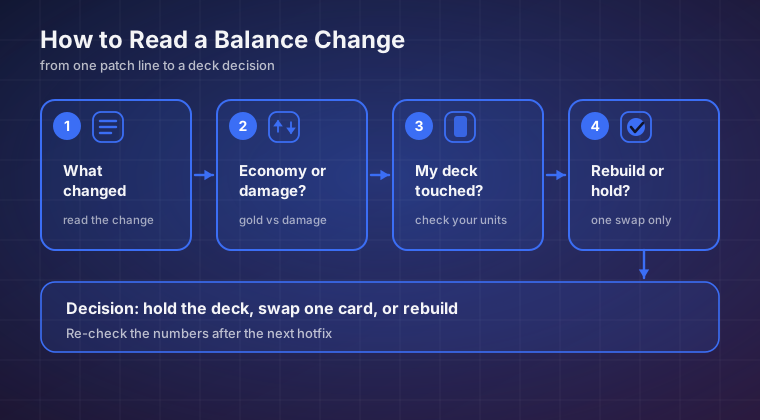
Read in a fixed order: buffs and nerfs first, new content second, fixes last. This keeps you focused on the changes that alter outcomes rather than the ones that only alter cosmetics or text.
Then hunt for the numbers. Official notes quote exact figures such as [X%] damage, [N] mana cost, [N] seconds of cooldown, or a merge-level threshold. Copy each one next to the old value if you can find it. A change means nothing until you know both the direction and the size.
The three questions that matter
Once you have the numbers, run them past three questions. Does the changed unit sit in my current five-card deck? Does it appear in the decks I keep losing to? And does the change hit the early game, the boss wave, or the whole match? If the answer to all three is no, the change is interesting but not urgent.
- Is the changed unit in my active five-card deck?
- Is it a common answer to my main damage dealer?
- Does the change touch mana economy rather than raw damage?
- Does it matter in the first two waves, the boss wave, or throughout the match?
- Does it affect co-op and clan wars the same way it affects solo PvP?
Turning a balance change into a deck decision
A balance change only becomes a deck decision once you connect it to your own list. If the nerfed unit is your main carry, the question is whether a [X%] reduction is survivable or whether you need to swap in a different damage source.
Mana economy changes deserve special attention. When a unit's cost or a merge reward moves by [N], the rhythm of your early waves shifts with it. A cheaper opener lets you merge faster; a pricier one forces you to defend longer with fewer units, which changes which support cards you can afford to run at all.
The safest reaction is patience. Play [N] matches with your current deck before you rebuild it. Small percentage changes often feel worse on paper than they do in practice, and your opponents are adjusting at the same time, so the meta moves with you.
New units, talents and seasonal content
When an update adds a [specific unit] or reworks a talent tree, do not assume you must own it. New units usually arrive strong, but the real question is whether they fill a gap your deck actually has. A shiny card that overlaps your existing carry adds pressure to your gold without improving your results.
Seasonal content such as a new season pass or event is mostly about rewards rather than raw power. Read what it pays out, then decide whether the time investment fits your schedule. A pass you cannot finish is not a bargain, no matter how good the top reward looks.
Talents are the quiet winners. A single talent change can turn a mid-tier card into a reliable support unit, and support units are often far cheaper to build than a brand-new carry. If you must spend after an update, spend where the change made something better, not where the marketing pointed.
Note. Treat every patch-note figure as a hypothesis, not a verdict. The official notes tell you what changed; only your own matches tell you whether it matters for your deck. Version [current version] balance values are moving targets, so confirm the live numbers in game rather than trusting a screenshot from last season.
Testing changes against your own deck
After you have the numbers, log a short set of matches and watch for two signals: how often your main unit reaches its merge cap, and how often you lose the first two waves. If your carry arrives later than before, the change touched your economy. If the early waves collapse, it touched your defense.
Keep one backup deck that does not rely on the changed unit. Swapping between two lists tells you far more than grinding a single deck and guessing, because it separates the effect of the patch from the effect of your own fatigue.
Finally, remember that Rush Royale is a live game with PvP leagues, co-op and clan wars. A change that hurts you in league play may be neutral in co-op, and a clan-war specialist deck may not care at all. Judge each mode separately before you spend gold or gems rebuilding.
Final verdict
Reading Rush Royale Update [current version] is not about memorising every line. It is about finding the handful of numbers that touch your five-card deck, checking them against your mana curve, and testing before you panic-rebuild. Fill in the bracketed placeholders with the real figures, then let your own matches confirm what the notes only suggest. Do this once per update and you will know within a few games whether the meta moved under you or merely shuffled around you.
Keep reading
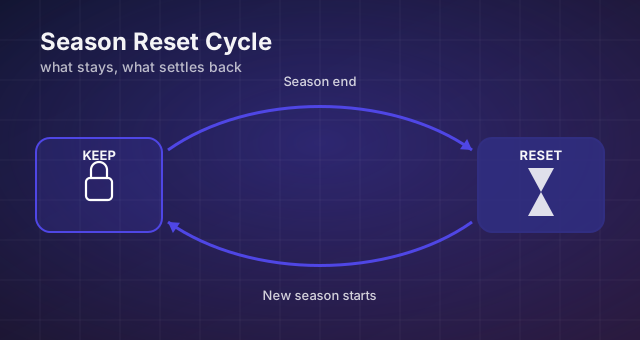
Rush Royale Season Reset: What Carries Over, What Resets and How to Prepare
What usually survives a Rush Royale seasonal flip, what gets settled back, and the checklist worth running in the week before it happens.
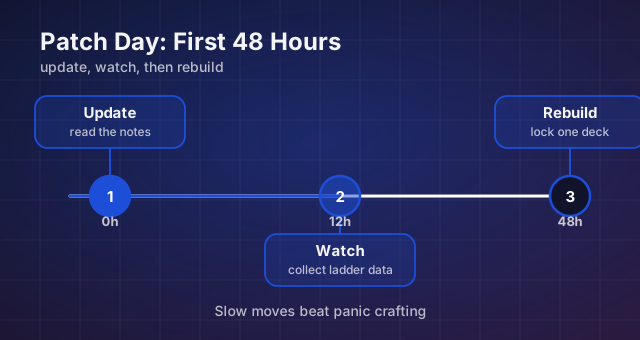
Rush Royale Patch Day: Your First 48 Hours After an Update
What to do — and what not to do — in the two days after a Rush Royale update, from reading notes in the right order to knowing when a nerf is only a paper one.
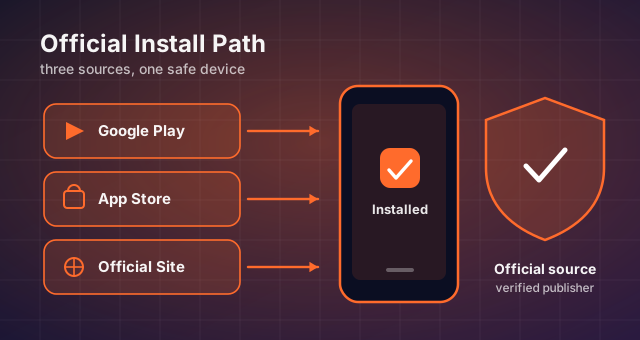
Rush Royale APK: Official Version, Requirements and a Safe Install Guide
What the Rush Royale APK actually contains, current Android requirements, how to update cleanly and how to spot a repackaged installer before it costs you your account.