
Units
Rush Royale Merge Mechanics: Every Rule Behind Ranking Up Units
Key takeaways
- Empty tiles are working capital — a full board cannot merge, and a board that cannot merge stops scaling.
- Merge into a boss window rather than during it; upgrading under pressure is what breaks runs.
- Ranking up what is already placed almost always beats adding another rank-one unit.
Every point of damage you deal is decided by one mechanic before it is decided by a card: merging two identical units of the same level to raise their rank. Recognizing and timing it is what separates players whose boards stall at rank two from players who reach meaningful ranks before the first boss. This guide covers the rules, the resource hidden in your empty tiles, when to merge and when to hold, and the specific losses that come from mis-merging.
How ranking up actually works
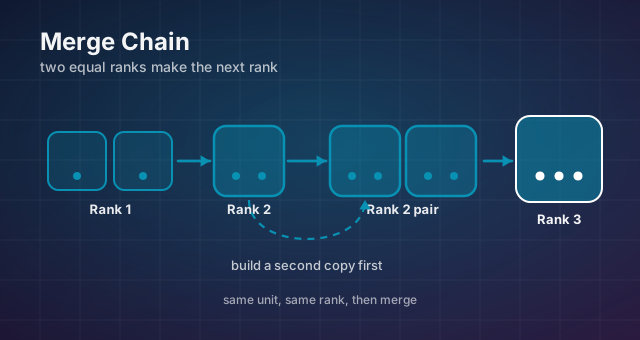
A merge takes two identical units of the same level and returns one unit a level higher. Cost per level is therefore exponential, not linear, so each step up consumes twice the units of the one before and your board density collapses as you climb.
That trade is the core tension of the game. Merging concentrates power into fewer tiles, so total tile coverage drops while per-attack output rises. Knowing whether the current wave rewards coverage or concentration is most of the skill.
Since units arrive from your five-card deck, draw frequency sets your realistic rank ceiling: a unit drawn twice per run cannot carry you.
Empty tiles are a resource, not a failure
New players read an empty tile as wasted board; experienced players read it as mana already invested in future merges, because every merge needs a destination and every new unit needs a landing tile.
Fully packing the board is one of the most common self-inflicted problems. With no free tile you cannot place, so mana accumulates unused, the deck stops cycling and pairs never form - you are locked out of ranking up until something dies.
Keep deliberate slack: two or three free tiles let you dump cheap duplicates, complete surprise merges and react to an unexpected boss lane.
- Never fill the last two tiles with units you do not intend to merge.
- Feed duplicates into an open lane rather than scattering them across the board.
- Before a wave, count free tiles and compare with the mana you are about to spend.
- If the board is locked, the correct move is usually to merge, not to wait.
Merge timing: before a boss wave versus between waves
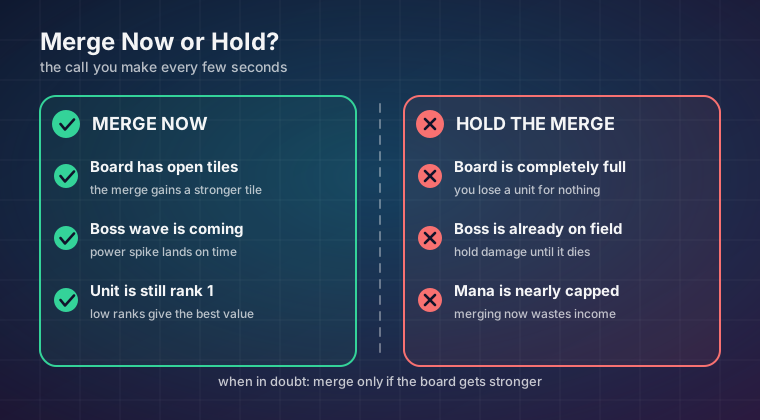
Regular waves give you a few calm seconds; boss waves give you neither calm nor spare attention, so never leave the conversion unfinished when the timer is about to flip.
Completing merges in the quiet window is the default rule. A merger performed mid-boss temporarily removes two attackers to create one, and if that single unit is still animating or repositioning you can drop the wave you were otherwise holding. Do the arithmetic early and arrive at the boss with the board already converted.
The exception is the boss that your current board simply cannot kill. If the boss is at [X%] health and climbing, an emergency merge into a higher-rank burst damage unit is the only line that wins, and it is better than watching the wave through. Emergency merges are a recovery tool, not a plan.
In PvP the same logic applies against opponent pressure, with one extra rule: merge while disruption is on cooldown, because committing board power just before an opponent's board wipe loses boards you had already won.
Board capacity and merge pressure
Every merge reduces the number of units on your board by one, which means merging is also your release valve for a full board. This is why high-level play looks alternating: fill to pressure the wave, merge to free space, fill again.
Whoever understands this builds to near-capacity and converts; whoever does not either sits idle at cap or merges too eagerly and fights waves with three units. The target is output per remaining wave time, not maximum possible rank.
The useful heuristic: once your average unit level cannot rise before the next boss, stop merging and start filling - raw coverage beats a ceiling that will not arrive in time.
Common merge misplays and what they cost you
Most losses blamed on "bad draws" are actually merge errors made a minute earlier. The table below maps each frequent decision to its real cost so you can catch it while it is still reversible.
| Merge decision | Make it when | Principal risk |
|---|---|---|
| Merging the last two copies of your main dealer | You have another damage source online | Total damage collapse; nothing left to kill the boss |
| Merging during a boss wave | The board cannot kill the boss otherwise | Temporary output drop loses the wave you were holding |
| Filling every remaining tile | Never, unless closing out the run | Board lock: no placements, no cycling, no future merges |
| Holding duplicates for a bigger merge | Quiet window and enough tile slack | Dead mana and lost coverage if the third copy never comes |
| Merging your mana unit away | Economy is already comfortable | Starved board for the rest of the run |
| Merging across the map into a bad lane | You can reposition afterwards | High-rank unit stuck where no lanes pass |
The costliest error is merging away your only source of a job. Before any merge ask what disappears: if the answer is all single-target damage or all mana income, wait for another pair.
A short practise routine
Spend one co-op session a day on a single rule: never let the board fill completely. You will merge more often than feels efficient, trading damage for constant cycling. Compare clear depth over [N] runs against your normal play.
Then add a second rule: no merges during boss waves unless the boss would otherwise survive. Track how often you needed the emergency merge - most players find it is near zero, which proves those merges should have happened earlier.
Final verdict
Merge mechanics reward players who treat the board as a managed economy rather than a collection of units. Empty tiles are working capital, rank is expensive by design, and the clock decides which of the two you can afford in any given second.
Internalise three rules and you will out-merge most of your bracket: never fully cap the board, do your merging between waves, and never merge away the only card performing a needed job. Everything else in this game gets easier once those are automatic.
Keep reading
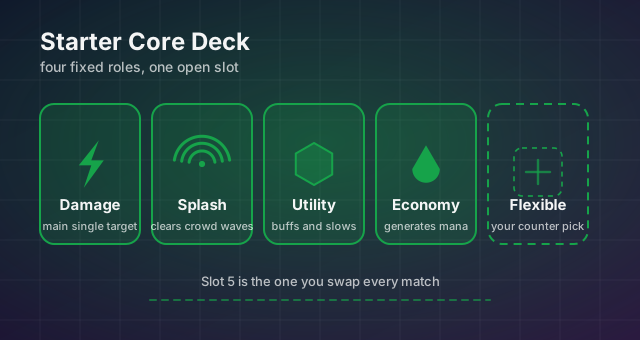
Best Rush Royale Units for Beginners: A Starter Core That Scales
How to choose the five cards worth levelling when your collection is thin: slot roles, screening criteria and why copying a ladder deck early backfires.
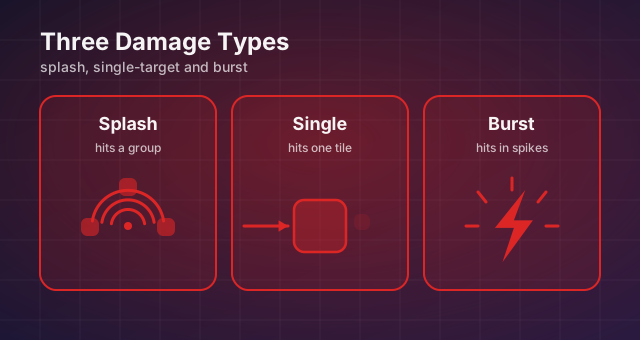
Rush Royale Damage Types Explained: Splash, Single-Target and Burst
The three damage profiles in Rush Royale, what each one answers, and why a single-target-only deck gets overrun by dense waves.
Rush Royale Support and Utility Units: Buffs, Slows and Mana Generation
Why the utility slot is the most underrated tile on your board — and the point where cutting it for raw damage actually makes sense.