
Units
Rush Royale Damage Types Explained: Splash, Single-Target and Burst
Key takeaways
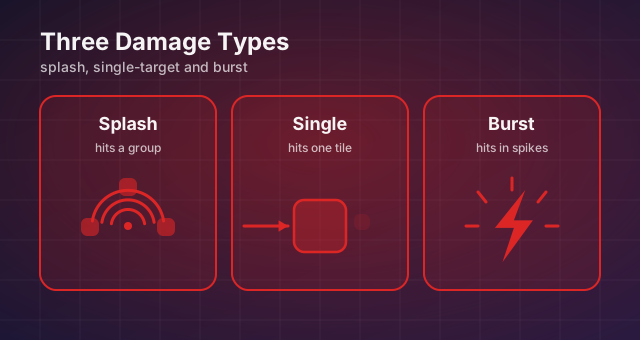
- Splash answers density, single-target answers bosses, burst answers tempo windows.
- A one-profile deck always loses to the wave shape it cannot answer.
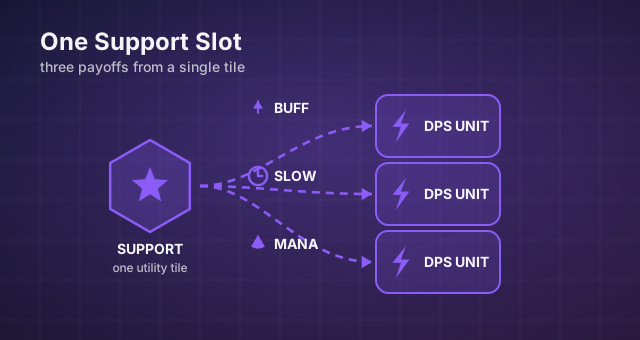
- Mix two profiles and let your utility slot cover the third role.
Rush Royale looks like a game about picking strong units, but most losses are actually a mismatch between how your deck deals damage and what the wave is asking for. Understanding the three broad output profiles - area, sustained single-target and short burst - tells you which fights you can take and which ones you should never have accepted. This guide explains each profile, the waves they solve, and exactly why an all single-target deck gets overrun.
The three damage profiles at a glance
Almost every offensive card falls into one of three buckets, and the buckets describe behaviour rather than rarity. What matters is not how much damage a unit deals in isolation but how that damage is distributed across targets and across time.
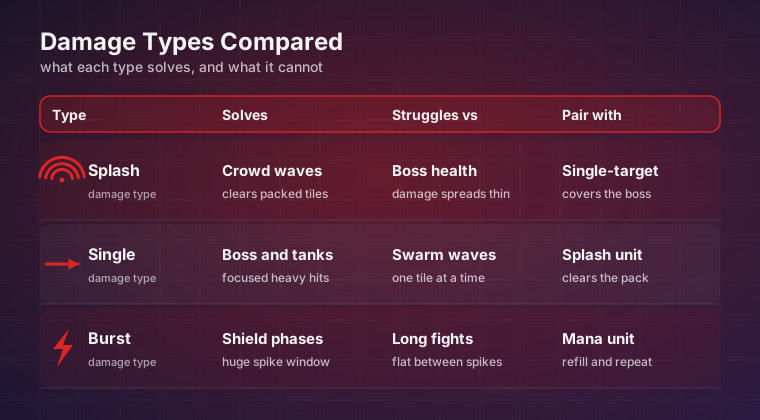
A splash-damage unit hits several enemies per attack, so its value scales with how many things are standing close together. A single-target damage dealer puts sustained pressure onto one enemy, so its value scales with that enemy's health pool. A burst damage unit delivers its output in short windows, so its value scales with preparation time and with how predictable the target is.
| Damage profile | Strong against | Weak against | Needs from the rest of the deck |
|---|---|---|---|
| Splash / area | Dense packs, swarm lanes, multi-lane pushes | Large single health pools; boss timers | A single-target unit to finish heavy targets |
| Sustained single-target | Bosses and other high-health enemies | Volume; anything arriving faster than it kills | Splash coverage and slows to protect it |
| Burst / windowed | Killing one dangerous threat before it acts | Continuous pressure and unpredictable waves | Economy and setup time, plus a safety net |
Read the table as a coverage checklist. A deck occupying two rows can answer most waves; a deck occupying one row has a hard counter somewhere in the mode rotation, and opponents in the leagues will find it.
Splash damage rewards density
Area damage is the answer to arithmetic. If twenty enemies enter a lane and your dealer kills one per second, you lose regardless of how strong that dealer is; a splash unit removes the same pack in the time it takes for three attacks.
This makes splash units the backbone of early and mid waves in every mode. They also forgive imperfect placement, because hitting "somewhere near the pack" is enough, whereas single-target units punish a misplaced tile by contributing almost nothing to that lane.
The constraint is ceiling. Area units rarely convert well against a lone boss, so they are a support structure for your dealer rather than a replacement for it.
Sustained single-target damage kills bosses
Boss waves are health-pool checks. The wave gives you a fixed number of seconds and asks whether your total focused output clears the pool before the timer does, so what you want is damage that never stops.
Sustained damage also fixes leaks efficiently. One heavy enemy walking past your splash core will reach your base unless something is dedicated to grinding it down, and a single-target unit does that without pulling your whole board off the lane.
Cost estimation matters here: these units want mana invested early so they can be merged before the boss arrives, rather than being placed at wave [N] and left at rank one.
Burst damage is a timing tool
Burst units convert preparation into a decisive moment. They are strongest when you can see the threat coming - a boss timer, an opponent's committed board - because their value depends on being ready before the window rather than reacting inside it.
What makes them risky is their floor. Outside the window they contribute little, so a burst unit raises your variance: spectacular when executed, close to dead weight when you are scrambling. Beginners should not run more than one.
Why a pure single-target deck gets overrun
This is the most common structural failure in low and mid leagues, and it looks unfair until you see the mechanic. A dealer killing one enemy per interval faces a wave producing several enemies per interval, so the board population grows without limit. Each survivor deals damage, slows your economy, and eventually the wave simply outnumbers you.
The failure compounds with targeting behaviour. Single-target units frequently switch targets, spreading partial damage across many enemies without finishing any - a full board of wounded survivors still deals full damage to you.
Because mana is finite, you cannot fix this by adding more of the same unit. Every additional dealer competes for the same resource, so the real fix is structural: add a splash unit, or add a control piece so fewer enemies arrive per second.
- Symptom: packs survive with slivers of health and reach your base - add area damage.
- Symptom: you clear everything but bosses survive the timer - add single-target.
- Symptom: you lose fights you were winning ten seconds earlier - you leaned too hard on burst.
- Symptom: mana empty, board half built - the problem is economy, not damage type.
Building a deck that covers every profile
A balanced five-card deck contains sustained single-target damage for bosses, splash for volume, and at most one burst option, alongside its economy and utility slots. That is four of five cards defined by function before you even consider individual unit identity.
Once the triangle is covered, tune by mode. Daily events and seasonal modifiers frequently change enemy density, which quietly shifts how much splash you need; clan wars lineups punish single-profile decks hardest because opponents can scout and counter them.
Final verdict
Damage types are a rock-paper-scissors problem disguised as a power-rating problem. The strongest-looking card in your collection is worthless against the wave shape it cannot answer, while a modest unit covering a missing profile is often the difference between clearing and losing.
Audit your deck against the table and name which row each card occupies. If two cards share a row, one of them is a candidate for replacement, because every duplicated profile is a matchup you have chosen to lose.
Keep reading
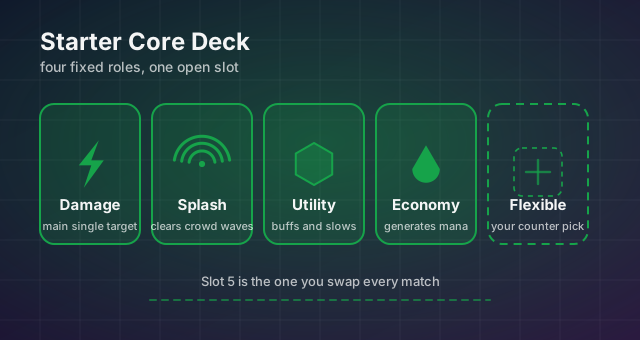
Best Rush Royale Units for Beginners: A Starter Core That Scales
How to choose the five cards worth levelling when your collection is thin: slot roles, screening criteria and why copying a ladder deck early backfires.
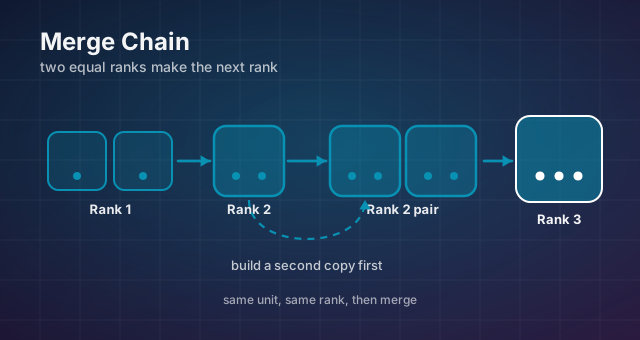
Rush Royale Merge Mechanics: Every Rule Behind Ranking Up Units
Rank thresholds, why empty board tiles are a resource, when to merge and when to hold, and the misplays that quietly cost you a run.
Rush Royale Support and Utility Units: Buffs, Slows and Mana Generation
Why the utility slot is the most underrated tile on your board — and the point where cutting it for raw damage actually makes sense.