
Guides
Rush Royale for Beginners: A Practical First 7 Days Roadmap
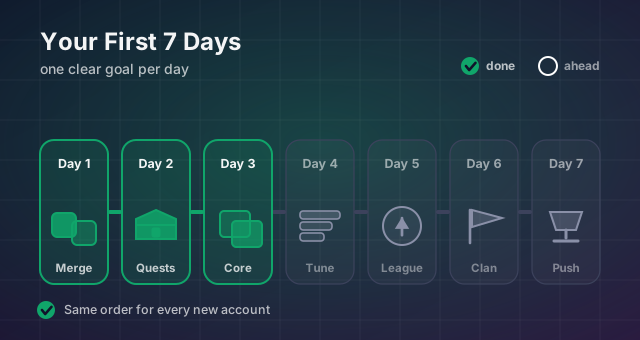
Key takeaways
- Keep a mana reserve instead of spending the bar the second it fills.
- Push your five core cards to higher levels rather than spreading gold across twenty.
- Join an active clan and run co-op daily — it is the steadiest income for new accounts.
Rush Royale pairs a merge board with real-time PvP tower defense, and the first week decides whether your account snowballs or stalls. This roadmap skips collection theory and focuses on the three decisions that actually move league progress: what you merge, what you spend, and which modes you queue. Install and update only through Google Play, the App Store, or the official MY.GAMES channels so your progress stays tied to official servers.
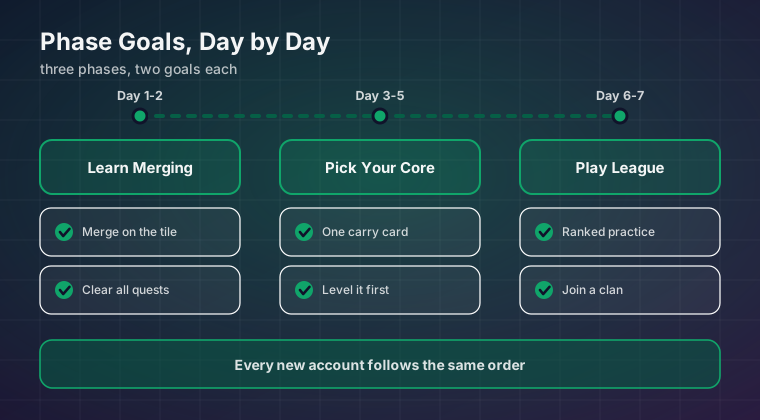
Days 1-3: learn the merge loop before you chase cards
Every match runs on two verbs: spend mana to place a unit, then merge two identical units of the same rank into one unit of the next rank. A merge does two things at once - it frees a board tile and it raises your damage per tile. That is why a tidy board of five high-rank units beats a crowded board of twenty rank-one units almost every time.
Your first real habit is keeping a small mana reserve instead of dumping the bar the moment it fills. Placing a unit costs mana, but the unit that wins the wave is the one you merge into, and merges are far cheaper when pairs are already sitting on the board. A player who spends on reflex stalls at the first boss; a player who waits two seconds and pairs units does not.
Queue PvP leagues immediately, even with a starter deck. League matchmaking pairs you with opponents at a similar stage, so the ladder is a tutorial that pays rewards. Grinding solo teaches nothing about timing, and timing is most of the skill in this game.
Waves, bosses, and where runs actually end
Waves arrive on a fixed rhythm, and every few waves a boss spawns with an ability rather than just a larger health bar. Bosses can disable units, shuffle your board, drain mana, or punish clustered placements. Because you rarely know which ability is coming, the safe habit is to spread your strongest units across tiles instead of stacking one corner.
Most lost runs are not lost to damage - they are lost to mana starvation. If you cannot place and merge fast enough, your board stops scaling while the wave timer keeps running. Watch the wave counter and the boss timer, not your health bar.
- Hold roughly one unit's worth of mana at all times so you can answer a board shuffle or a disable.
- Merge the lowest-rank pairs first; they clog tiles and return the least value.
- Do not fill every tile early - empty tiles are exactly what make merges possible.
- When a boss is about to spawn, stop expanding and spend on ranking up what is already placed.
Gold, gems, and chests: where the value is
Gold funds card upgrades, and gems are the premium currency used for chests, cosmetics, and pass tiers. Upgrades are the true power curve: a plain deck at a higher card level outperforms an exotic deck at level one. Choose the five cards you actually play and push their levels before touching anything else.
Chests drop cards and resources, and keys unlock them. Never let chest slots sit full, because a full slot means the next chest you earn is simply wasted. Open on a schedule, and spend keys during events that add bonus drops when those are live.
The season pass (battle pass) has a free track and a paid track. Finish the daily and weekly missions even as a free player, because the free track alone is a meaningful share of monthly resource income. Buy the paid tier only if you play often enough to complete it.
| Resource | Best early use | Common mistake |
|---|---|---|
| Gold | Leveling your five core cards | Spreading upgrades across every card you own |
| Gems | Chests and pass value, saved for events | Trading gems for tiny instant gains |
| Keys | Unlocking chests before slots fill | Hoarding keys while chest slots overflow |
| Chests | Opened steadily, timed with bonus events | Letting earned chests expire in a full slot |
Co-op and clan wars: your upgrade engine
Co-op is a two-player mode with a shared board and heavier wave pressure. Teams that win agree on roles before wave one: one player builds the mana economy, the other converts that mana into damage. If both build damage, nobody can afford merges; if both build economy, the wave timer kills you.
Clan wars pit clans against each other over a set period and pay out on participation as much as on results, so a losing clan war still returns value. Join an active clan in your first days. The reward track matters, but the bigger win is having people who will tell you which of your five cards is dragging the deck down.
Rotating daily events change modifiers and rewards, so check the event tab before spending anything. Resources spent inside an event window usually return more than the same resources spent outside one.
A 20-minute daily routine that compounds
Progress here is mostly a function of consistency. A focused twenty minutes beats a two-hour weekend session, because quests, chest cycles, and event windows are all time-gated. Start with daily quests, spend your keys, run two or three co-op matches with a clanmate, then finish with a short PvP session to turn what you learned into league progress.
In version [current version] the exact quest list and event names change from season to season, but the order of operations does not: collect, spend, co-op, queue.
Final verdict
Your first seven days should produce exactly three things: a stable five-card deck you understand, a habit of merging instead of spamming, and a clan that runs co-op with you. Everything else - collection size, cosmetic unlocks, league trophies - is downstream of those three. Players who struggle at week three are almost always the players who spread gold across twenty cards and never learned to read a boss timer.
Treat the roadmap as a loop rather than a checklist. Each day you should be able to name the one card you upgraded, the one mechanic you practiced, and the one resource you did not waste. Do that for a week and the mid-league wall stops feeling like a wall.
Keep reading
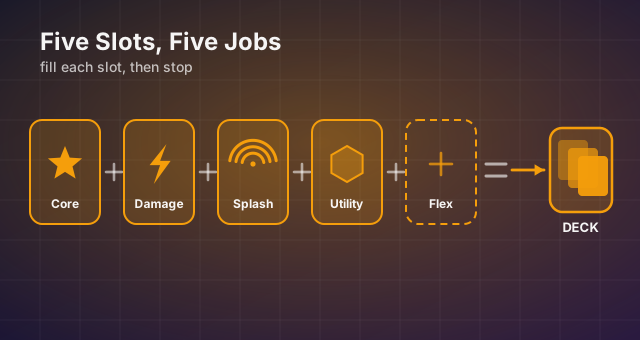
Rush Royale Deck Building: How to Build Five-Slot Decks That Win
Slot roles, merge maths and three archetypes that hold up in ranked — plus how to tune a single slot instead of rebuilding everything after a loss.
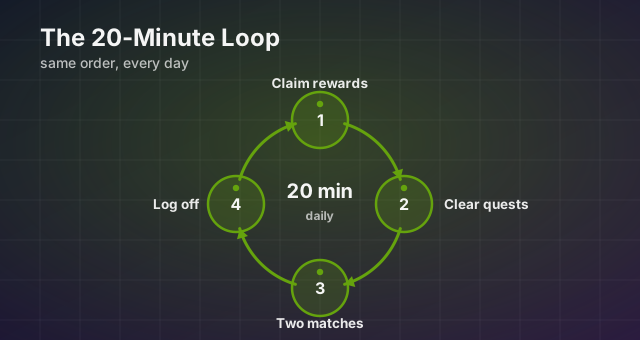
Rush Royale Daily Routine: A 20-Minute Loop That Compounds
A repeatable daily, weekly and seasonal checklist that clears every renewable reward without eating your evening.
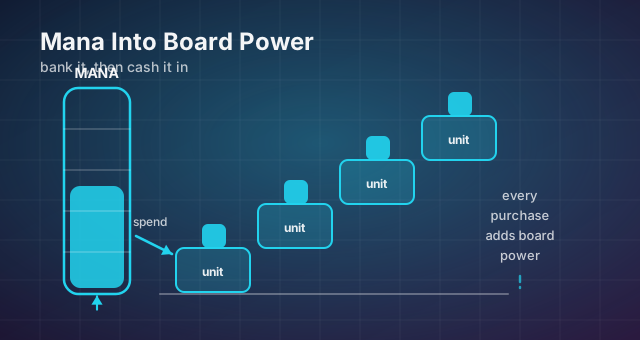
Rush Royale Mana Economy: How to Convert Mana Into Board Power
The spending curve that separates players who scale past the first boss from players who stall with a full board of rank-one units.