
Guides
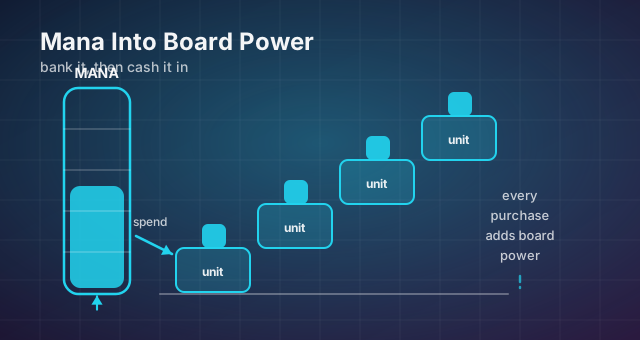
Rush Royale Mana Economy: How to Convert Mana Into Board Power
Key takeaways
- Mana spent upgrading what is already placed usually beats mana spent adding another low-rank unit.
- Time spending around boss waves: stop expanding and rank up before the boss lands.
- In co-op, split roles — one player builds economy, the other converts mana into damage.
Mana is the only resource you actively manage during a Rush Royale match, and nearly every lost run is a mana error wearing a different costume. Players blame cards, opponents, or bad draws, then look up and see a full mana bar they failed to spend or an empty one they overspent thirty seconds earlier. This guide treats mana as an economy: income, timing, and conversion rate into board power.
What mana actually buys
Mana pays for board actions. It places units, and depending on the mode it also funds the in-match rank-ups that let a single unit keep pace with the wave timer. It regenerates over time and, in most decks, faster when you run a mana-generating support unit. Gold and gems shape your account between matches; mana decides the match you are in.
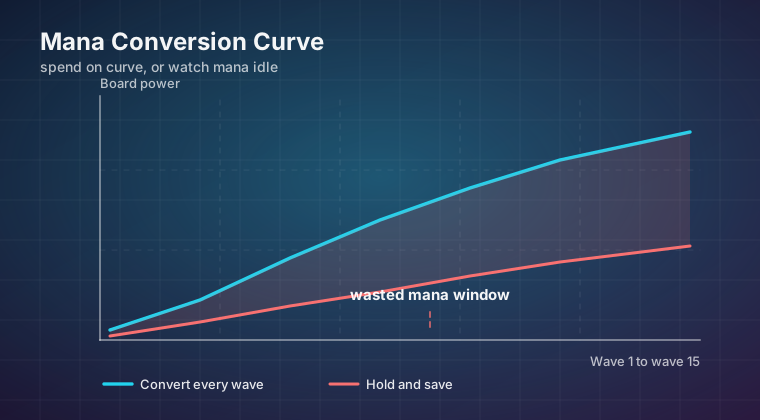
The critical framing is that mana is income, not savings. A full mana bar is income you threw away, because regeneration stops at the cap while the wave timer keeps running. Conversely, mana spent on a unit you never merge is mana converted into clutter. Both errors look identical on the scoreboard and have opposite fixes.
Track two numbers while you play: your regeneration rate and your cost to complete a merge. Once you know roughly how many seconds it takes to afford your next meaningful action, you can plan a whole wave instead of reacting to it.
The spending curve: ramp, convert, spike
A match has three economic phases. Early waves are for ramping: place cheap units, establish economy, and start pairs. Mid waves are for converting: merge aggressively so your damage per tile climbs. Late waves and boss windows are for spiking: hold a reserve, then spend it all in a few seconds to answer the threat.
The most common beginner leak is spending in the wrong phase. Players spike early, run dry at the first boss, and then watch a stalled board lose to a timer. The second most common leak is the opposite - hoarding mana through the mid game, which quietly caps your income and leaves you with a low-rank board at wave twenty.
- If the bar is near cap and no boss is coming, spend immediately - capped mana is wasted mana.
- If a boss timer is under a few seconds, stop expanding and bank instead.
- Spend on merges before spending on new placements when tiles are scarce.
- After a boss dies, reinvest the breather into economy rather than into one more damage unit.
- Never leave a mana-generating unit at low rank while a damage dealer sits at high rank.
Economy units are the engine, not a luxury
A mana-generating support unit is the highest-leverage tile on the board for most of the match, because it raises every future action's affordability. Placed early and ranked up, it pays for itself several times over. Placed late, it is a wasted tile, since there is not enough match left to amortize it.
The trade-off is real, though: every economy tile is a tile not holding damage. The practical answer is count, not kind. Zero economy units means you cannot sustain merges; three or four economy units means you have a beautiful income and no board. For most decks, one or two dedicated economy units is the sweet spot, and the second one should come out the moment you stop affording merges.
Treat economy units as protected assets. When a boss shuffles or disables part of the board, re-establish economy before you rebuild damage. Damage recovers with one good merge; income lost at wave fifteen never comes back.
Spending around bosses and wave spikes
Bosses matter economically because they interrupt your plan rather than simply adding health. Abilities that drain mana, disable units, or reshuffle tiles all attack the conversion rate between mana and board power, so the correct response is a reserve: enter the boss window with enough banked mana to rebuild after the ability resolves.
Panic spending is the expensive mistake here. Players see a boss, dump the whole bar into scattered low-rank units, and then have nothing left when the disable lands. Bank first, let the ability resolve, then spend the reserve into merges that actually scale.
| Match phase | Mana priority | Typical leak |
|---|---|---|
| Opening waves | Cheap placements and economy setup | Buying an expensive unit that never finds a pair |
| Mid waves | Merging pairs to raise damage per tile | Hoarding until the bar caps and income stops |
| Pre-boss window | Banking a reserve for the ability | Panic-spending into scattered low-rank units |
| Post-boss breather | Rebuilding economy, then damage | Skipping economy and stalling two waves later |
Co-op and events change the arithmetic
In co-op, two players share one board and one wave pressure, so the economy question becomes a role assignment: one player funds, one player converts. Two players both building economy produce a rich board with no damage; two players both building damage produce the mana starvation you already know how to lose to. Agree before wave one and repeat the same plan every run.
Rotating daily events and clan war modifiers shift the same numbers. A modifier that raises spawn cost makes economy units mandatory rather than optional. A modifier that lowers it rewards aggression instead. Read the modifier text before you queue, then change your opening ten seconds rather than your whole deck.
Final verdict
Once you see mana as an economy, the game reads differently: you stop asking "which card is strongest" and start asking "how fast does this card convert mana into surviving the next wave." That question has a stable answer, and it survives balance patches far better than any specific unit choice.
Practice one drill until it is automatic: glance at your mana bar every time the wave counter ticks, and never let it sit capped while tiles are empty. Players who internalize that single habit climb leagues on modest decks, because their board keeps scaling after everyone else's has already stopped.
Keep reading
Rush Royale for Beginners: A Practical First 7 Days Roadmap
The three decisions that decide whether a new Rush Royale account snowballs: what you merge, what you spend, and which modes you queue.
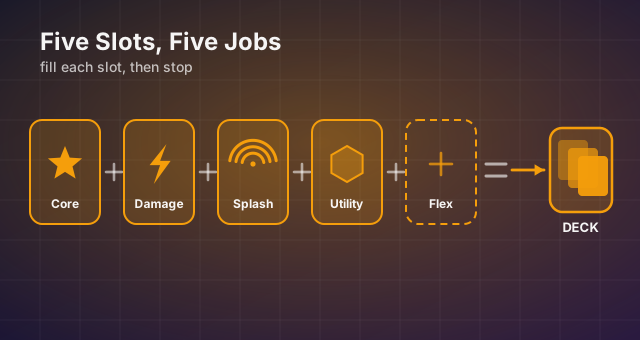
Rush Royale Deck Building: How to Build Five-Slot Decks That Win
Slot roles, merge maths and three archetypes that hold up in ranked — plus how to tune a single slot instead of rebuilding everything after a loss.
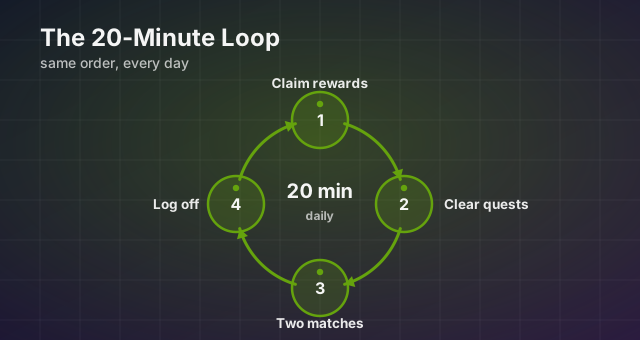
Rush Royale Daily Routine: A 20-Minute Loop That Compounds
A repeatable daily, weekly and seasonal checklist that clears every renewable reward without eating your evening.