
Guides
Rush Royale Deck Building: How to Build Five-Slot Decks That Win
Key takeaways
- Every five-slot deck needs a damage core, an economy unit and a utility slot.
- Empty board tiles are what make merges possible — do not fill every slot early.
- Tune one slot for the matchup you keep losing instead of rebuilding the whole deck.
A Rush Royale deck is only five cards, which makes every slot expensive: one wrong pick is twenty percent of your entire strategy. Strong decks are not collections of the highest-rated cards, they are five cards that cover five jobs and merge reliably under a wave timer. This guide breaks the five slots into roles, shows three archetypes that hold up in league play, and gives you a repeatable way to tune a deck after a loss.
The five slots are five jobs, not five favorites
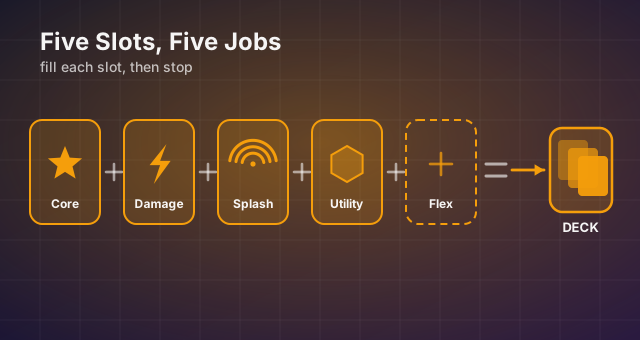
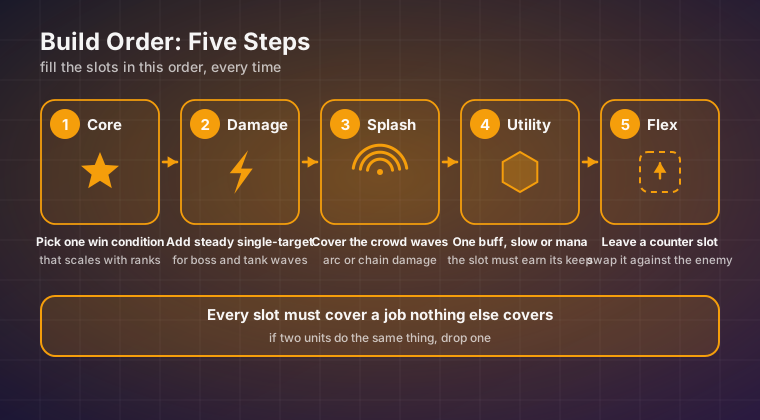
Think of a deck as a job posting rather than a power ranking. A workable five-slot deck needs a single-target damage dealer for bosses, an splash-damage unit for dense waves, a mana-generating support unit to fund the board, a utility unit that slows or debuffs, and one flex slot you swap per matchup.
This framing matters because units arrive randomly from your five cards. A deck of five premium damage dealers has no economy, so it places three units, runs dry, and dies at the first boss. A deck with a dedicated mana unit and a splash unit converts the same mana into far more board power, because it can keep placing and merging all match.
When you cut a card, cut by job coverage, not by rarity. Ask which of the five jobs disappears when the card leaves. If the answer is "none, it was a second copy of a job I already have," the cut is correct even if the card is strong on paper.
Deck building is really merge math
Merge probability is the hidden stat of every card. Since the game offers you units drawn from your five cards, a card that is expensive to place will sit on the bench while cheaper cards cycle, and a card you rarely place is a card you rarely rank up. Cheap cards find pairs; expensive cards need patience you do not have during a boss wave.
A balanced cost curve therefore beats a deck of five heavy hitters. Aim for at least one genuinely cheap unit you can spam for pairs, two mid-cost units that carry your damage, and at most one expensive payoff unit. If your opening ten seconds cannot produce a merge, the deck is too top-heavy.
- Can this unit be placed often enough to reach rank three or higher in an average match?
- Does it still do its job at low rank, or does it only matter once fully merged?
- Does it work alone, or does it require another specific card to be useful?
- If I draw three copies in a row, is that a good outcome or a wasted board?
Three archetypes that survive league play
Instead of memorizing card names, learn the shape of a deck. Three shapes cover most of what you will meet in the leagues, and knowing which shape you are playing tells you what your win condition and your panic button are.
| Archetype | Core idea | Where it breaks |
|---|---|---|
| Burst / boss-killer | Heavy mana economy feeding one high-rank single-target dealer | Dense fast waves overwhelm the board before the payoff lands |
| Splash control | Area damage plus slows, wins by clearing volume | Bosses with large health pools take too long to kill |
| Ramp economy | Two mana units, bank early, spike hard after the mid waves | Aggressive opponents punish the weak early board |
Newer players should start with splash control. It is the most forgiving shape because area damage covers placement mistakes, and a slow effect gives you time to fix a bad board. Once you can read the wave timer, move to burst or ramp, which reward precision with much higher ceilings.
Support units earn their slot
One support slot multiplies the other four. A mana-generating support unit is the clearest example: it does not appear on the damage meter, but it is the reason your dealer reaches a meaningful rank before the boss arrives. Damage buffs, armor shred, and slows work the same way - they convert existing board power into more board power.
Be careful with stacking. Many effects in this game do not scale linearly when duplicated, so two identical buffers usually return less than one buffer plus one debuffer. Read each card's in-game description rather than assuming, and prefer variety: one offensive amplifier, one defensive or control effect.
The other half of synergy is placement geography. Units with area effects want to sit where the most lanes pass; units that buff adjacent tiles want neighbors, not corners. Building a deck around a synergy you cannot physically arrange on the board is a common self-inflicted loss.
Tuning for the mode and the matchup
Your flex slot exists because PvP, co-op, clan wars, and rotating daily events do not ask the same question. PvP rewards a deck that survives an opponent's disruption and still kills bosses. Co-op rewards a deck that complements your partner's, since you share one board. Events often add modifiers that quietly invalidate a card you relied on yesterday.
Adjust by symptom rather than by tilt. If you die to bosses, add single-target damage. If you die to volume, add splash. If you die with an empty mana bar and half a board, add economy. That single diagnostic habit fixes more decks than any tier list, and it works in every mode.
Final verdict
Good deck building in Rush Royale is mostly restraint. Five slots, five jobs, a cost curve that produces merges, and one slot you are willing to change when the mode changes. Players who chase individual strong cards end up with five overlapping jobs and no economy; players who build by role end up with decks that survive bad draws.
Keep a short deck journal: the five cards, the job each one fills, and the wave where your last three runs ended. Within a week the pattern will be obvious, and you will be editing decks for reasons you can explain instead of reasons that felt right.
Keep reading
Rush Royale for Beginners: A Practical First 7 Days Roadmap
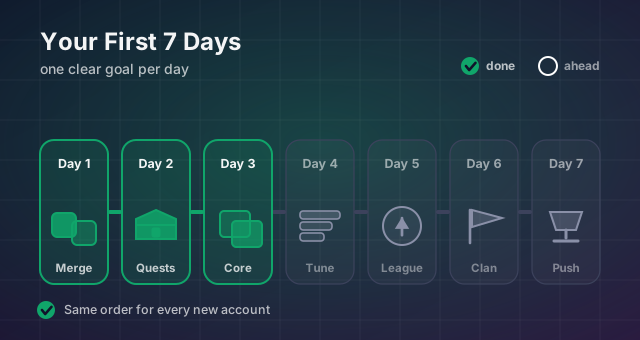
The three decisions that decide whether a new Rush Royale account snowballs: what you merge, what you spend, and which modes you queue.
Rush Royale Daily Routine: A 20-Minute Loop That Compounds
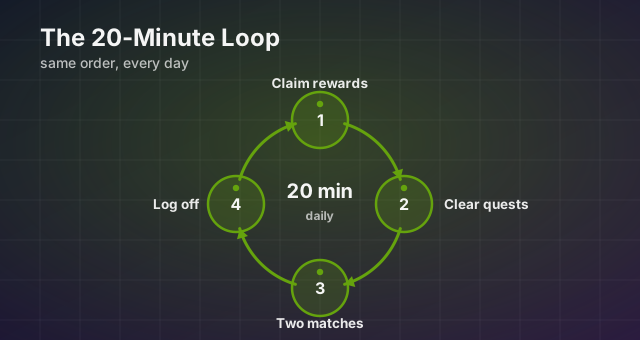
A repeatable daily, weekly and seasonal checklist that clears every renewable reward without eating your evening.
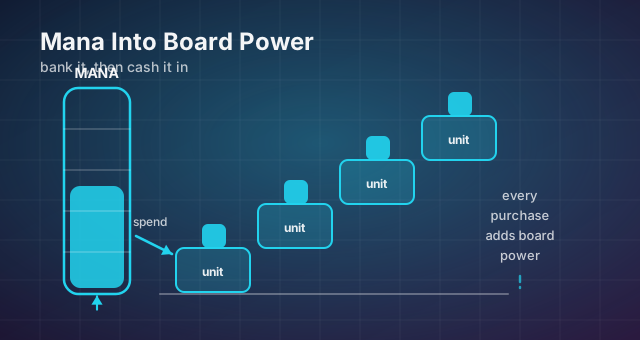
Rush Royale Mana Economy: How to Convert Mana Into Board Power
The spending curve that separates players who scale past the first boss from players who stall with a full board of rank-one units.