
Guides
Rush Royale Progression: Which Cards to Level First and Where Gold Goes
Key takeaways
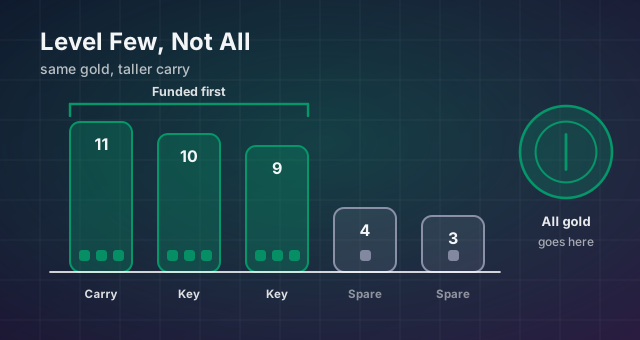
- Concentrated upgrades on five cards outperform spreading gold across a wide collection.
- Gems are worth more as permanent capacity than as a shortcut to one more chest.
- Every third-party service offering currency you have not earned is a phishing and malware risk, never a shortcut.
Gold is the scarcest meaningful resource in Rush Royale, and the way most accounts waste it is not bad luck but arithmetic: spreading upgrades evenly across a collection feels like progress while actually making every deck weaker. This guide covers why concentrating on five core cards beats averaging, how to decide when a core card should be replaced, where gems are genuinely best spent, and which purchases to refuse.
Why five levelled cards beat twenty half-levelled ones
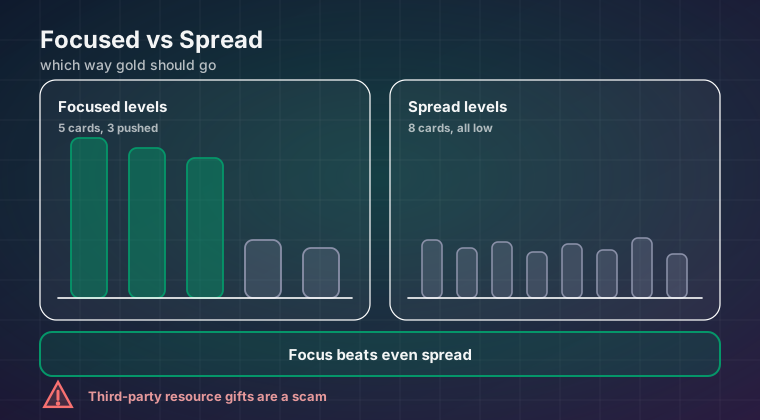
A deck is five slots. Every upgrade for a card outside those slots is invisible in the matches you actually play. Split gold evenly and you arrive at every league match with five mediocre cards against an opponent who put the same gold into five strong ones.
Concentration also compounds with the merge system: a higher-rank core card improves every merge you make with it all match, while a marginal upgrade on a card you rarely place changes nothing. Levelling pays off in proportion to how often you actually use the card.
The rule: pick five cards, commit for at least a full season, and route every upgrade into them. Cards outside the five get gold only when a core card is being retired and its replacement needs to catch up.
Choosing your core five, and when to swap one
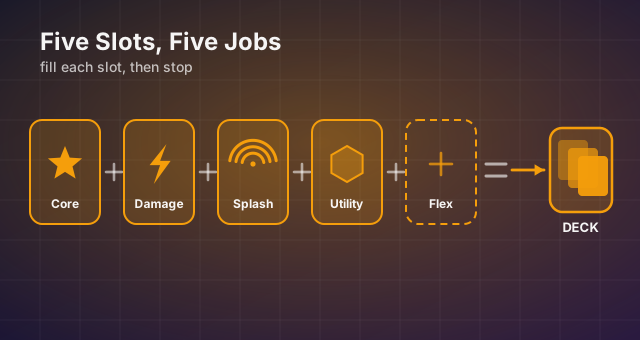
Choose by job, not by rarity. A working core covers single-target damage for bosses, splash damage for dense waves, one mana economy unit, one utility or control unit, and one flex card. If two of the five do the same job, one is a luxury and should be replaced by coverage you lack.
Then sanity-check the cost curve. At least one card should be cheap enough to place and merge repeatedly in the opening seconds, and at most one should be an expensive payoff. Five expensive cards look impressive in the collection screen and fail to produce merges under a wave timer.
Swapping a core card is expensive, so require a real reason. Valid: the job is no longer needed after a seasonal change, you have a clearly better card for the same job at a comparable level, or the job itself has become obsolete. Invalid: one bad match, a card you find more fun, or a single loss.
Where each resource should go
Every currency in the game has one best use and several tempting bad ones. The table is the short version; the sections after it explain the two that matter most.
| Resource | Best use | Common waste |
|---|---|---|
| Gold | Levelling your five core cards, one at a time, to the cap you can currently afford | Spreading small upgrades across the whole collection; upgrading cards you never place |
| Gems | Permanent capacity or long-term unlocks, and the season pass when you will actually finish it | Converting into small amounts of gold; impulse spending on cosmetics you forget |
| Chest keys | Opening chests every day so the regeneration timer never sits at the cap | Hoarding keys for weeks; letting the timer idle at maximum |
| Season pass progress | Finishing the track during the season it belongs to | Grinding a track you cannot finish in the remaining days |
| Event currency | The single highest-value reward in the event shop, claimed before the event ends | Spending it on low-value filler and losing the rest at reset |
| Duplicate cards | Feeding your core upgrades | Holding duplicates of cards outside your five "just in case" |
- Before any upgrade, name the slot it improves. No slot, no purchase.
- Never leave keys at the cap; idle regeneration is invisible lost income.
- Finish one upgrade completely before starting the next.
- Re-check event shops on the final day of the event, not the first.
Where gems should actually go
Gems are the premium currency and the easiest thing in the game to waste in small increments. Their value is highest when spent on something permanent, because permanent unlocks keep paying you back every season, while a one-time conversion into gold is consumed once and disappears.
The season pass is the exception worth understanding: it is good value only if you will finish the track. Estimate honestly from your daily routine - buy it early so rewards work all season, or skip it and put gems into permanent value.
Avoid gem-to-gold conversion except in genuine emergencies. It is priced to be unattractive and rarely changes a single match. The same applies to skipping timers: patience is free, gems are not.
Third-party currency offers are a scam, not a shortcut
Any third-party site, app, or social account claiming it can add gold or gems to your Rush Royale account is lying: balances are stored server-side by the publisher, and no outside tool can change them. That includes giveaway posts, surveys promising in-game currency, browser extensions claiming to top up your account, and downloadable currency files.
There is no outside tool, no working currency trick, and no shortcut of any kind. What these offers actually deliver is one of three outcomes: a phishing form that harvests your login credentials, a download that installs malware or adware on your device, or an endless loop of surveys and ads that pays the operator while giving you nothing. Handing over account details can also mean losing a linked Google Play or App Store account, not just one game.
If you already entered credentials on such a page, change the password for that account and for any other account that reused it, enable two-factor authentication where available, and scan the device. Acting quickly limits the damage; hoping the offer was real does not.
Final verdict
Concentrate. Five well-levelled cards carry you further than a broad collection of half-upgraded ones, and ignoring cards outside your core is most of what separates fast accounts from stalled ones. Swap a core card only for a structural reason, and only after the replacement is levelled.
Then be conservative with gems and sceptical of everything else. Permanent value beats consumable value, patience beats skipping timers, and every offer of currency you have not earned takes from you rather than gives. Spend inside the game, or not at all.
Keep reading
Rush Royale for Beginners: A Practical First 7 Days Roadmap
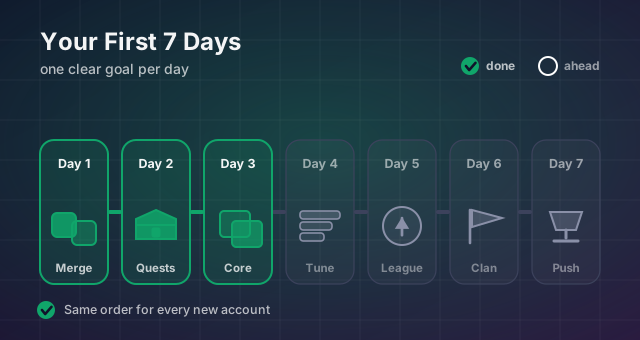
The three decisions that decide whether a new Rush Royale account snowballs: what you merge, what you spend, and which modes you queue.
Rush Royale Deck Building: How to Build Five-Slot Decks That Win
Slot roles, merge maths and three archetypes that hold up in ranked — plus how to tune a single slot instead of rebuilding everything after a loss.
Rush Royale Daily Routine: A 20-Minute Loop That Compounds
A repeatable daily, weekly and seasonal checklist that clears every renewable reward without eating your evening.