
Meta
Rush Royale Off-Meta Decks That Still Win Ranked
Key takeaways
- Off-meta wins come from unfamiliar pacing, not from secretly broken cards.
- Pick a direction your upgraded cards already support rather than forcing a rebuild.
- Abandon the experiment when it starts losing to decks it was meant to beat.
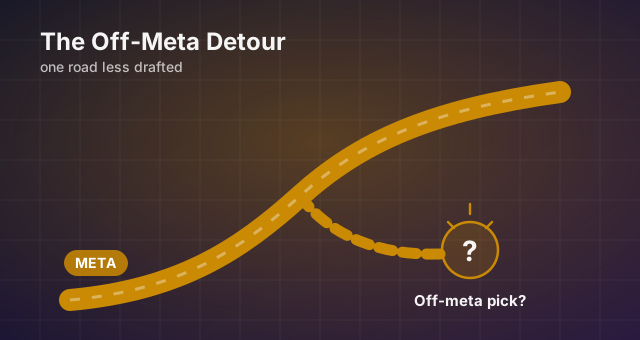
Off-meta decks win in ranked not because they are secretly stronger, but because opponents have rehearsed answers to the popular builds and none to yours. Every unfamiliar timing is a small free advantage, and in a real-time mode where decisions happen under a wave timer, unfamiliarity is expensive. This guide covers how to choose an off-meta direction, how much card depth it actually needs, and when to walk back to a standard list.
Why off-meta works in a five-card format
Ranked play rewards predictable execution more than raw power. Most players at any given league have internalised one timing: when the popular archetype normally spikes, when it normally runs out of mana, when it normally panics. If you reproduce that timing, you are playing a solved game against someone who has solved it.
An off-meta deck shifts the spike. Maybe your damage arrives one wave earlier and is smaller, or your economy comes online later but produces a wider board. Either way the opponent's mental clock is wrong, and a wrong clock produces two specific errors: over-committing mana into a wave that did not need it, and holding mana for a threat that never arrives.
This edge decays as you climb, because stronger players identify archetypes by behaviour rather than by card. It never disappears completely, though, and it is strongest in the mid leagues where players know the meta lists well enough to counter them but not well enough to improvise.
Picking a direction that is actually different
Off-meta does not mean random. A deck is off-meta in a useful sense only if it changes a decision the opponent has to make. Five cards that are individually unpopular but functionally identical to the standard build give you all of the weakness and none of the surprise.
Three directions reliably change the opponent's decisions. A tempo direction spikes earlier and forces reactive spending. A scaling direction accepts a weak early board in exchange for a late board that out-ranks everything. A disruption direction leans on slows, debuffs, or board interference and wins by making the opponent's deck operate below its normal efficiency.
Pick the direction that matches your temperament, not your collection. Players who dislike holding mana will misplay scaling decks even when the deck is good, and players who get impatient will ruin tempo decks by committing too early. The best off-meta pick is the one whose failure state you can tolerate calmly.
How much card depth you actually need
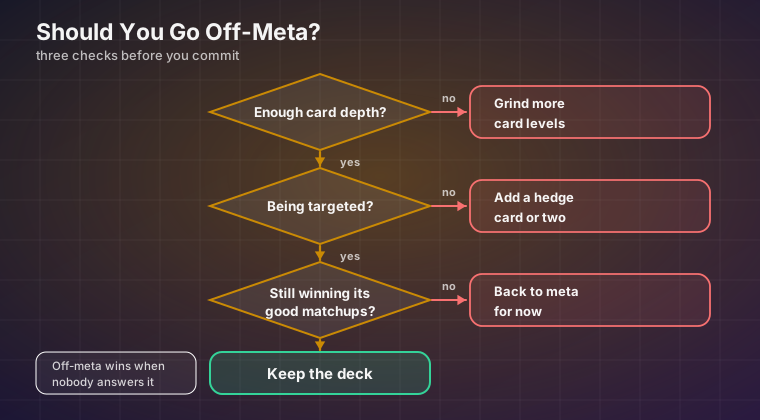
The hidden cost of off-meta is level investment. A standard list benefits from the cards everyone already upgraded; an off-meta list needs its own levels, and a half-levelled unusual deck is worse than a fully levelled boring one. Decide the depth question before you commit, not after.
A practical rule: at least four of the five cards should sit at a level comparable to your main deck's core. The fifth can lag a rank or two if its job is utility rather than damage. If three of five are clearly under-levelled, the deck loses to players it should beat and you will blame the strategy for what is really a resource problem.
Off-meta directions at a glance
Use this table as a shopping list. "Investment" means the realistic card-level work required before the deck performs, not the time spent practising it.
| Direction | Edge | Main risk | Investment needed |
|---|---|---|---|
| Early tempo | Forces reactive mana spending before opponents are ready | If the early push fails, you have no late plan | Two cheap units at high rank, moderate |
| Late scaling | Out-ranks standard boards in the late waves | Aggressive opponents end the game before you scale | Two economy cards plus a payoff unit, high |
| Disruption / control | Makes popular decks operate below their normal damage | Weak against opponents who clear waves quickly regardless | One utility core card, low to moderate |
| Hybrid splash | Covers dense waves while staying flexible | Single-target boss damage can fall short | One splash unit plus one single-target unit, moderate |
| Economy denial | Punishes mana-hungry meta lists specifically | Does very little against already-cheap decks | Situational, low but narrow |
- Choose one direction and stay on it for at least twenty matches.
- Track the wave you die on: if it is always the same wave, it is a deck problem; if it varies, it is a play problem.
- Never run two untested cards at once - you will not know which one is failing.
- Keep your standard list intact in a second deck slot so retreating costs nothing.
When to abandon the experiment
Set an exit condition in advance, because otherwise you will defend a bad idea for weeks. The clean test is not win rate, it is why you lose. If your losses come from identifiable mistakes you could fix with practice, keep going. If they come from your board simply having less power than the opponent's at the same wave, the direction is under-levelled or wrong, and more practice will not fix it.
Three signals mean stop. First, the meta has adapted: opponents now answer your timing correctly, removing the only advantage you had. Second, a seasonal change or league modifier has invalidated the deck's core assumption. Third, your win rate is fine but matches run much longer than usual, so you are grinding rating inefficiently even while winning.
Switching back is not a failure of creativity. Strong ranked players usually keep one standard list for rating and one experimental list for learning, and alternate based on where they are in the season. Early in a season is the cheap time to experiment; the last days before reset are not.
Final verdict
Off-meta works because ranked opponents are running scripts, and any deck that breaks the expected timing charges them a small tax on every decision. The tax is real, but it is smaller than the cost of an under-levelled deck, so the depth question always comes first.
Pick one direction, fund four of the five slots properly, test outside ranked, and write your exit condition down before you start. That turns an experiment into a project with a result, instead of a stretch of losses you later explain away as bad luck.
Keep reading
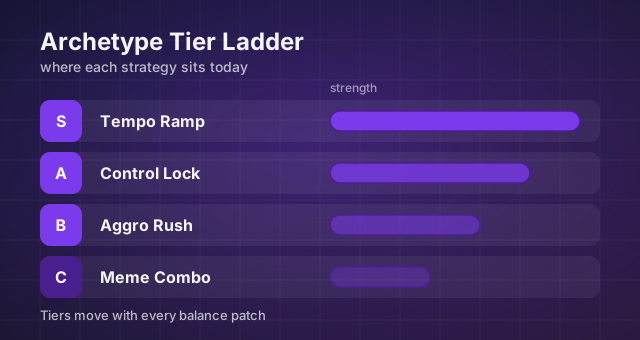
Rush Royale Deck Archetype Tier List: Which Strategy Wins Right Now
S to C tier ranking of Rush Royale deck archetypes with win conditions, best and worst matchups, and the collection depth each one needs before it starts winning.
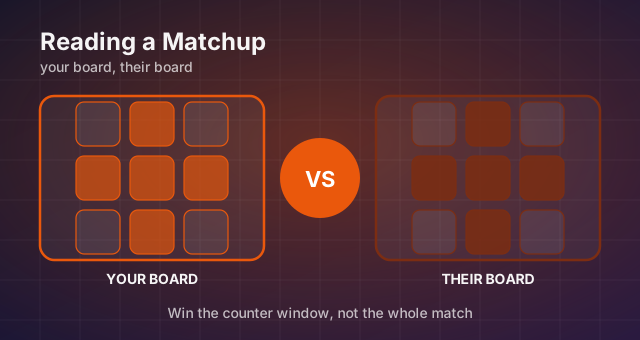
Rush Royale Matchups: How to Beat the Three Decks You Keep Losing To
Reading an opponent's archetype in the first wave, finding your counter window, and knowing which single slot to change between games.
Rush Royale Clan Wars Explained: Roles, Scoring and Weekly Routines
How clan war scoring actually rewards participation, which roles matter in a war, and the weekly routine that keeps a clan competitive without burning anyone out.