
Meta
Rush Royale Clan Wars Explained: Roles, Scoring and Weekly Routines
Key takeaways
- Participation alone pays most reward tracks, so consistency beats raw win rate.
- Agree on economic versus damage roles before the first attack goes in.
- Run attacks on a fixed weekly schedule so nobody carries the clan alone.
Clan Wars is the mode where individual skill stops being enough. You are no longer playing a deck, you are playing a schedule: who attacks, with what, and when. This guide covers how the weekly cycle works, the roles a healthy clan actually needs, how scoring usually adds up, and a routine you can copy even if your clan is brand new.
How Clan Wars works
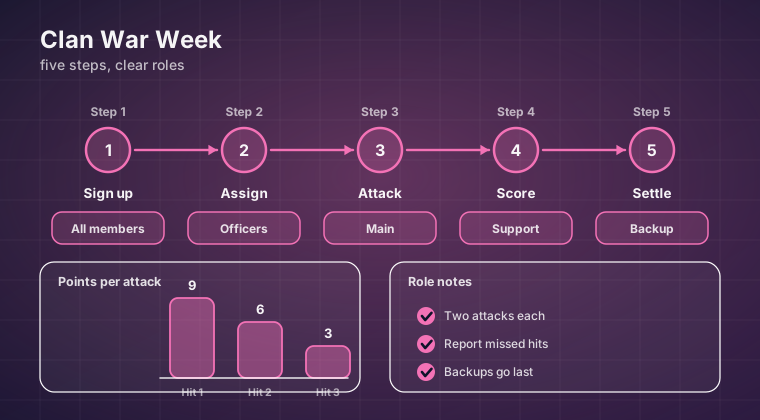
Clan Wars matches your clan against another clan over a fixed cycle, normally one week. Members spend limited attempts or energy to play sets of matches, and every set contributes points to a shared clan total. When the cycle ends, the clan with the higher total takes the better reward tier.
The key detail is that war matches are not ladder matches. Opponents come from a rival roster rather than open matchmaking, so scouting matters, and a narrow counter deck often scores better than a strong generalist.
Exact numbers - attempts per member, points per win, cycle length - shift between updates. Treat anything numeric as [X] and confirm it in the war screen instead of trusting an old screenshot.
Roles a war clan actually needs
Most clans fail not because members are bad, but because everyone is doing the same job at the same time. Five players all attacking the same target with the same archetype produce fewer points than five players covering different jobs. Assign roles explicitly before the cycle starts.
| Role | Job during the cycle | Skills it rewards | Time cost |
|---|---|---|---|
| War organizer | Sets the target order, assigns matchups, tracks the score gap | Knowing archetype matchups and reading the rival roster | High, but mostly between matches |
| Point scorer | Takes the highest-value sets and converts them into wins | Strong mechanics with a main PvP archetype | Medium, concentrated in a few sessions |
| Co-op specialist | Pairs with a partner for the two-player sets | Shared-board discipline and complementary deck building | Medium, requires scheduling with one other person |
| Scout / reporter | Records what the rival clan runs and posts counters | Reading decks quickly, short notes | Low, minutes per check |
Small clans can merge roles, but the jobs do not disappear. If nobody scouts, everyone guesses. If nobody tracks the score gap, the clan over-commits early or panics late.
How scoring usually adds up
War scoring rewards participation first and quality second. The clan total is the sum of individual results, so a clan of twenty active members with average decks usually beats a clan of eight strong players who only log in twice. This is the single most useful thing to understand about the mode: attendance is a strategy.
Beyond raw wins, cycles add weighting: high-value sets sit behind tougher opponents, later waves, or a co-op requirement, so the organizer decides who takes the expensive sets and who farms the cheap ones.
Consistency matters too. With limited attempts, a player who wins three of four sets beats a player who wins one brilliantly and loses three.
A weekly routine you can copy
Wars reward rhythm over heroics. Below is a schedule that works for most clans; compress it if your cycle is shorter than a week.
| Phase | What the clan does | Why it matters |
|---|---|---|
| Cycle start | Organizer posts the rival roster, target order, and assignments | Stops two players taking the same set |
| First 24 hours | Scouts play cheap sets and report what rivals run | Intel beats early points |
| Middle of cycle | Scorers take high-value sets using scout reports | Counters need a known matchup |
| Co-op block | Paired members run two-player sets together | Shared boards punish solo improvisation |
| Final day | Fillers clear leftovers; organizer decides whether to chase | Unspent attempts are lost points |
| After the cycle | Five-minute review: sets lost, decks that underperformed | Clans improve only if someone writes down why |
Preparation happens outside the war
Players who perform in wars are not practising during wars, they arrive prepared. Preparation is mostly unglamorous: a main deck you can pilot without thinking, a counter deck tuned for the matchups you keep meeting, and enough gold banked that you are not mid-upgrade when the cycle opens.
Deck prep should follow archetype logic rather than card names, because rosters change: keep one late-scaling deck and one early-pressure deck and most rival lineups are covered.
- Confirm your five-card deck still covers splash, single-target, and mana economy before the cycle starts.
- Bank resources for at least one emergency upgrade rather than spending everything the moment you get it.
- Note your own win rate by archetype - it is more useful than any public ranking.
- Decide in advance which sets you are happy to take, so the organizer can plan around you.
- Keep one co-op partner whose deck genuinely complements yours, and schedule together.
Communication beats mechanics at the clan level. A clan of average players who post assignments, report results, and spend every attempt will outscore a clan of strong players who never talk. If you can only improve one thing this week, improve the chat.
Mistakes that lose wars
The first is burning every attempt in the first hours. Early enthusiasm feels productive, but it spends your limited attempts before scout reports exist, which means the most valuable sets get played blind. Hold roughly a third of the clan's attempts for the second half of the cycle.
The second is roster churn. Wars reward clans that know each other's decks: a stable member who loses two sets and reports why is worth more than a fresh recruit who wins one and disappears. Recruit for reliability and activity windows, not just trophies.
The third is ignoring the score gap. Far ahead means stop taking risky sets and bank guaranteed value. Behind by a small margin means the opposite: cheap wins will not close it, so take the high-value sets while attempts remain. Deciding this deliberately beats defaulting to "play everything".
Final verdict
Clan Wars is a scheduling and information game wearing a PvP costume. Get the basics right - clear roles, scouted matchups, every attempt spent - and your clan will climb reward tiers without a single member changing their deck. Get them wrong and no amount of individual skill covers the gap.
Start small this cycle: assign two roles, run the scout phase properly, and review afterwards. That routine compounds.
Keep reading
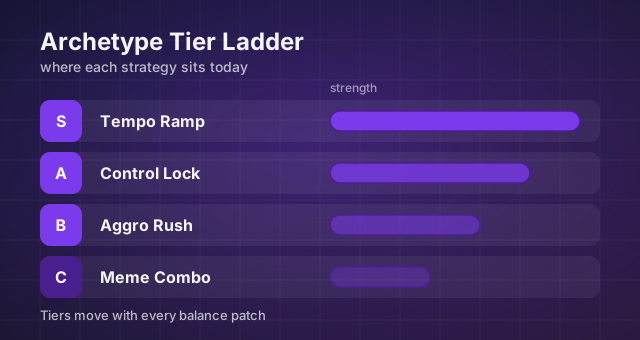
Rush Royale Deck Archetype Tier List: Which Strategy Wins Right Now
S to C tier ranking of Rush Royale deck archetypes with win conditions, best and worst matchups, and the collection depth each one needs before it starts winning.
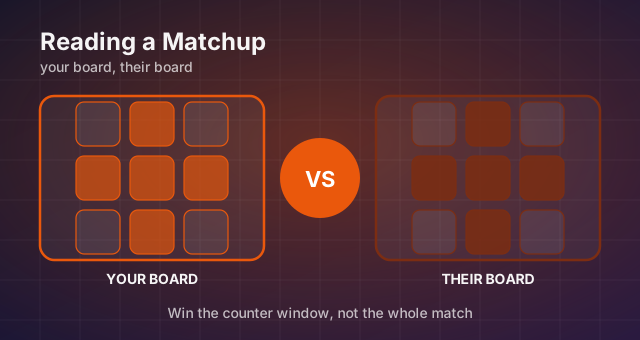
Rush Royale Matchups: How to Beat the Three Decks You Keep Losing To
Reading an opponent's archetype in the first wave, finding your counter window, and knowing which single slot to change between games.
Rush Royale Off-Meta Decks That Still Win Ranked
Why unfamiliar decks beat stronger ones on the ladder, how to pick an off-meta direction, and the collection depth it actually needs.