
Modes
Rush Royale Leagues and Ranked Seasons: How Climbing and Resets Work
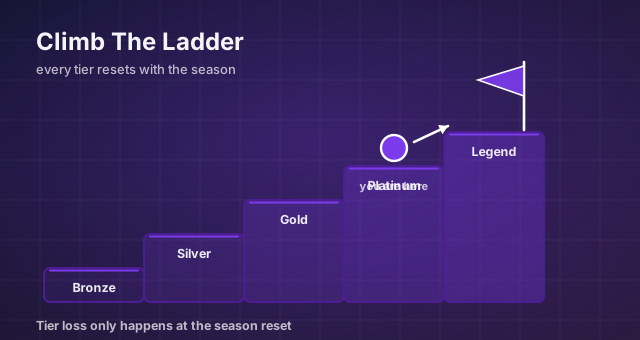
Key takeaways
- Being stuck at a tier is nearly always a card-level problem, not a decision-making one.
- Push rating early in a season when the field is mixed, and stop after two straight losses.
- Use the reset window to re-check which archetype your upgraded cards actually support.
Leagues are where Rush Royale measures your account rather than your mood. The ladder is simple to enter and easy to misread: players blame losses on decisions when the real constraint is card level, and then grind into opponents their deck cannot yet beat. This guide covers the ladder structure, what resets actually change, and how to tell a skill gap from a collection gap.
How the ladder is structured
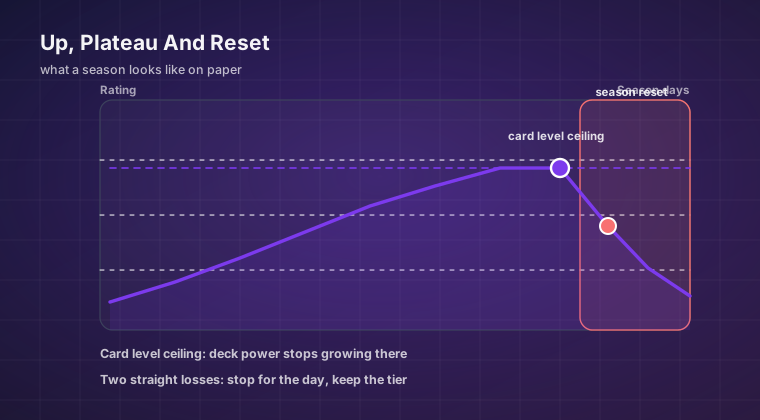
League play is a rating ladder. You queue a five-card deck, both players face the same wave set, and the rating moves on the result. Bands exist along the way - early leagues where almost any coherent deck climbs, mid leagues where matchup knowledge starts to matter, and upper leagues where deck levels decide most games before the first wave lands.
Two properties matter more than the band names. First, rating moves asymmetrically: a win and a loss are rarely the same size, which is why a roughly even win rate can still not be enough to climb. Second, matchmaking widens as you climb, so the opponents get statistically stronger at exactly the moment your progress slows.
Because of that, the ladder is best read as a measuring instrument. Your band tells you roughly what your collection is worth right now, and it moves when the collection moves.
What a season reset actually changes
A ranked season runs for a fixed period, then resets rating back toward the lower bands and starts a new season pass track. The reset does not touch your cards, gold, or gems. Your collection carries over in full; only the ladder position and the seasonal reward track restart.
That has a practical consequence: the weeks after a reset are the worst time to push. Everyone with a strong collection is compressed into the low bands, so early-season matches are harder than the same rating will be three weeks later. Players who rush the reset get matched against accounts that simply out-stat them.
The better pattern is to treat the first stretch of a season as a farming period - dailies, events, chests - and let the field spread out before you spend serious games on the ladder.
When to push and when to stop
Push when three conditions line up: your deck has not changed recently, you have a block of uninterrupted time, and you are winning more than you lose in your current band. Stop when any one of them breaks, not when you feel tired - tilt is a symptom, not the trigger.
A concrete stop rule beats willpower. Quit after two consecutive losses, or after a fixed number of matches per session, whichever comes first. Rating lost in a bad hour costs more games to recover than the hour gained, because the losses also drop you into opponents who punish an under-levelled deck harder.
- Do not queue a freshly changed deck into a push session; test it in co-op or events first.
- Stop at two straight losses, and do not "win one back before bed."
- Avoid the first days after a reset unless your collection is already deep.
- Bank rating near the end of a season rather than gambling it for one more band.
- Track your win rate per deck, not per session; per-session numbers are noise.
Why being stuck is usually a deck-level problem
The uncomfortable truth about the ladder is that most plateaus are not mechanical. If you consistently reach roughly the same band and stall, the cause is almost always deck depth: the number of cards you own at a competitive level, and whether your five slots cover the roles a long match demands.
The diagnostic is straightforward. If you lose because your board is statistically behind - your units die to waves your opponent clears comfortably - that is levels. If you lose because you spent mana badly, merged late, or misread a boss timer, that is play. Players overwhelmingly report the first kind of loss and train for the second.
Depth matters because the ladder punishes narrow collections. One strong card carries you through the early bands and then stops, because opponents at higher bands have five strong cards and their total output simply exceeds yours. Broadening the deck - even at slightly lower level on each card - usually raises the ceiling more than pushing a single carry from [N] to [N+1].
The correction is unglamorous: pick the five cards you will actually queue, funnel upgrade materials into them, and resist spreading resources across cards you never play. A focused deck of five at a good level beats a wide collection of fifteen at a mediocre one.
End-of-season checklist
The last stretch of a season is about converting, not climbing. Finish whatever pass tier is realistically reachable, spend remaining event currency, and decide deliberately whether one more push is worth the risk of dropping a band.
| Ladder band | What usually gates you | Realistic action |
|---|---|---|
| Lower leagues | Deck coherence - five slots with no clear roles | Rebuild the five slots around damage, splash and mana support |
| Mid leagues | Upgrade level on your main damage dealer | Funnel gold into one carry; stop spreading upgrades |
| Upper-mid leagues | Deck depth - one card cannot match five strong ones | Level the whole five-card set before adding new options |
| Upper leagues | Matchup knowledge and boss timing | Here skill finally dominates; review lost waves, not lost games |
Season length, band count and reset rules are adjusted by the developers from time to time. Check the in-game ranked screen for the current season's dates and rewards rather than relying on any fixed numbers.
Final verdict
Rush Royale's ladder is a fair measurement of your collection, and a poor measurement of your talent. Treat each band as feedback about which part of your deck is weakest, fix that between sessions, and climb when the deck is ready instead of when you feel motivated.
The players who reach high leagues are not playing more matches than everyone else. They are playing fewer matches with a focused five-card deck, stopping before rating bleeds, and timing their push for the part of the season when matchmaking is kindest.
Keep reading

Rush Royale Game Modes Explained: PvP, Co-op and Rotating Events
Every queue in Rush Royale side by side: what you actually do in each one, what it pays out, and how often it is worth your time.
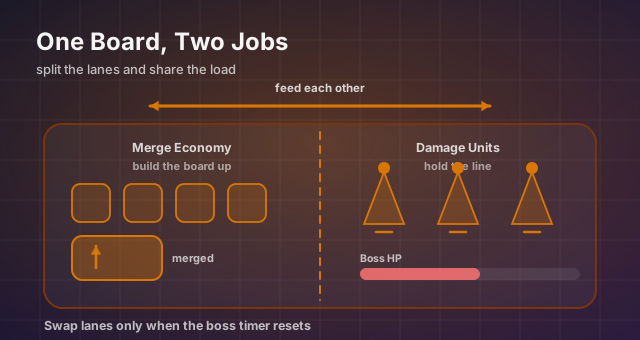
Rush Royale Co-op: Roles, Pacing and How to Carry Without Carrying
Splitting economy and damage duties with a partner, syncing merge pace to boss timers, and the mistakes that sink two-player runs.
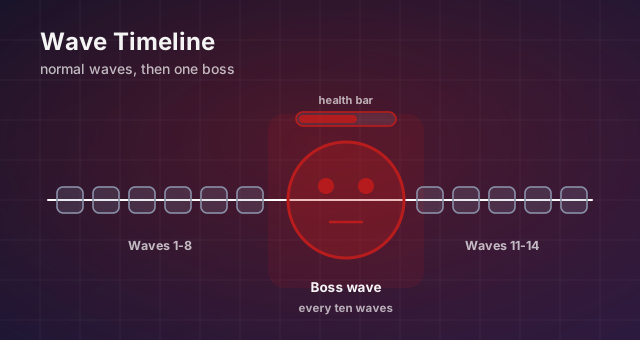
Rush Royale Boss Waves: Timers, Mechanics and Survival Patterns
Why boss waves decide most runs, the preparation that beats them, and how to read the three boss archetypes before they land.