
Modes
Rush Royale Boss Waves: Timers, Mechanics and Survival Patterns
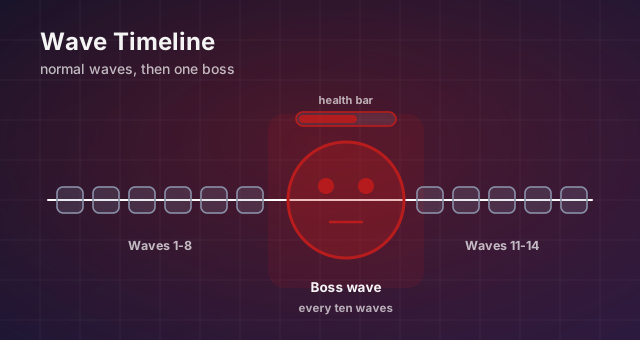
Key takeaways
- Stop expanding and start ranking up before the boss timer runs out.
- Every boss punishes one thing: slow damage, crowded boards or unprepared cooldowns.
- Surviving the boss is worth more than the extra rank-one unit you were about to place.
Every Rush Royale run is decided by a handful of boss waves and not by the dozens of ordinary waves between them. Bosses interrupt your plan rather than merely adding health, which is why a board that looked unstoppable can evaporate in seconds. This guide covers the preparation window, the broad boss archetypes, and the survival patterns that keep a run alive past the point most players fold.
Why bosses are the watershed
Normal waves test throughput: can your board kill things as fast as they arrive. That is a gradual check, and a slightly weak board fails slowly enough that you can notice and fix it. Boss waves test something else - your ability to absorb a scripted disruption and still function afterwards.
That difference is why boss waves, not total wave count, define how far a run goes. Two players with identical decks can finish ten waves apart purely on whether they were prepared when the timer flipped. In co-op the effect is doubled, because both players hit the same disruption with a shared tile supply.
Practically, this means you should plan a match as a sequence of boss windows rather than as a single long grind. Everything you do between bosses exists to make the next one survivable.
The pre-boss preparation window
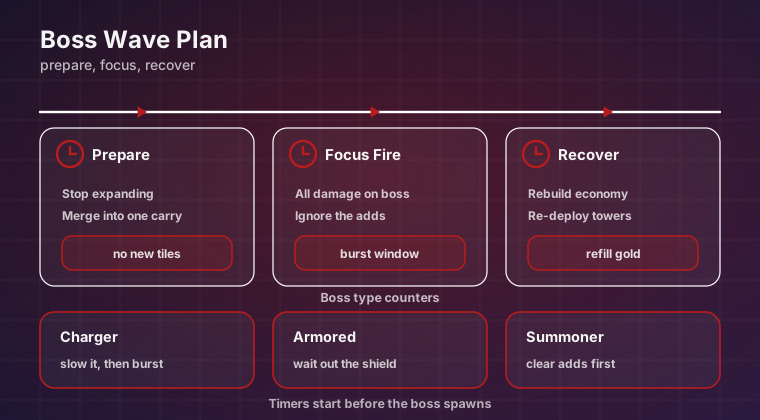
Most boss deaths are caused in the five seconds before the boss appears. The correct preparation has three parts, and they need to happen in this order.
Stop expanding. New placements made just before a boss are the worst-value mana in the game: they arrive unranked, they consume tiles you will need, and if the boss shuffles or disables them they were pure loss. Once the boss timer is visible, placement stops.
Rank up what exists. Merging two mediocre units into one strong one is worth more than adding a third mediocre unit, and it also frees a tile. Spend the window converting pairs instead of growing the board.
Bank mana. Enter the boss with a reserve, because several boss types attack your resources directly. A full bar when the ability resolves lets you rebuild immediately; an empty one leaves you watching a disable tick down with nothing to do.
- Watch the wave timer, not the health bars - the boss is a scheduled event.
- Finish merges first, then bank; a half-merged board is worse than a small one.
- Keep at least two tiles free so a shuffle has somewhere to land.
- Do not spend the reserve pre-boss unless the current wave is genuinely leaking.
- In co-op, both players compress on the same beat or the board stays half-ready.
Boss archetypes and how to answer them
Rush Royale bosses differ in mechanic rather than in raw stats, and the correct response depends entirely on which kind you are facing. You do not need to memorise names - you need to recognise the category from what the ability does to your board. The three broad families below cover almost everything you will meet.
The high-health single target is a straight damage check: it walks in with a large health pool and a timer, and if your board cannot out-damage it, you lose. The answer is burst, not spread - one high-rank damage dealer plus a ranked splash-damage unit beats four low-rank attackers.
The board-disruption family attacks your layout instead of your health: shuffles, disables, or forced conversions. Here survival is about recoverability, so the answer is a banked reserve, free tiles, and re-establishing your mana support before you rebuild damage.
The debuff family weakens your units - damage reduction, attack slowdown, or ongoing damage over time. These punish low-rank boards disproportionately, which makes ranking up before the window the entire defence.
| Boss type | Primary threat | Response priority |
|---|---|---|
| High-health single target | Timer runs out while it is still alive | Concentrate rank into one burst damage dealer and one splash-damage unit |
| Board-disruption (shuffle or disable) | Layout and income destroyed at once | Bank mana and free tiles; rebuild economy before damage |
| Debuff / damage-over-time | Low-rank units become useless and clog tiles | Rank up before the window; merge away weak singles |
| Summoner or wave-amplifier | Adds volume your board cannot clear | Splash damage and crowd control take priority over single-target burst |
| Resource-drain | Mana removed, so no rebuild is possible | Enter with a reserve and protect mana support units |
Timers and ability discipline
The visible boss timer is the most under-used piece of information on screen. It converts panic into a schedule: you know exactly how long you have to finish merges, and exactly when spending must stop. Players who lose to bosses usually did not misplay the ability - they were still mid-expansion when it landed.
Discipline means three specific refusals. Refuse to place a unit in the final seconds before a boss. Refuse to dump the whole bar the instant the boss appears. And refuse to rebuild blindly - wait for the ability to resolve, then spend into merges that scale rather than into replacements for what just died.
Panic-spending is the expensive habit here. The bar empties into scattered low-rank units, the disable lands, and there is nothing left for the rebuild that actually decides the wave.
Recovery: the wave after matters more
Surviving the boss is not the same as surviving the run. The wave immediately after is where most "I beat the boss and still lost" runs end, because the board is damaged, income is gone, and the next normal wave arrives before recovery finishes.
Recovery order is fixed: economy first, then damage. Re-establish your mana-generating support unit, merge the survivors into fewer stronger units, and only then start placing again. Damage recovers with one good merge; income lost at a late wave never comes back.
Once income is stable, use the quiet stretch to expand aggressively - this is the only part of the match where expansion is safe. Then compress again for the next boss, and repeat the cycle.
Final verdict
Boss waves are the real skill test in Rush Royale, and they are almost entirely about timing rather than card quality. Stop expanding when the timer appears, convert pairs into rank, bank a reserve, and let the ability resolve before you spend. That sequence alone turns most boss losses into survived waves.
The rest is recovery discipline. Rebuild economy before damage, expand only in the quiet window, and treat each boss as a scheduled event you prepare for rather than a surprise you react to. Runs end when players forget the schedule, not when their deck runs out of power.
Keep reading

Rush Royale Game Modes Explained: PvP, Co-op and Rotating Events
Every queue in Rush Royale side by side: what you actually do in each one, what it pays out, and how often it is worth your time.
Rush Royale Co-op: Roles, Pacing and How to Carry Without Carrying
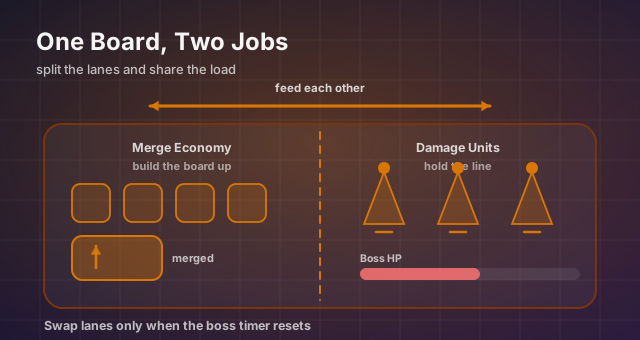
Splitting economy and damage duties with a partner, syncing merge pace to boss timers, and the mistakes that sink two-player runs.
Rush Royale Leagues and Ranked Seasons: How Climbing and Resets Work
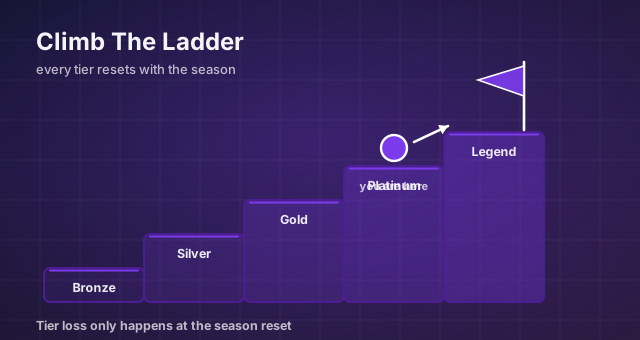
How league tiers and seasonal resets actually work, when to push rating and when to stop, and why your ceiling is usually a collection-depth problem.