
Modes
Rush Royale Co-op: Roles, Pacing and How to Carry Without Carrying
Key takeaways
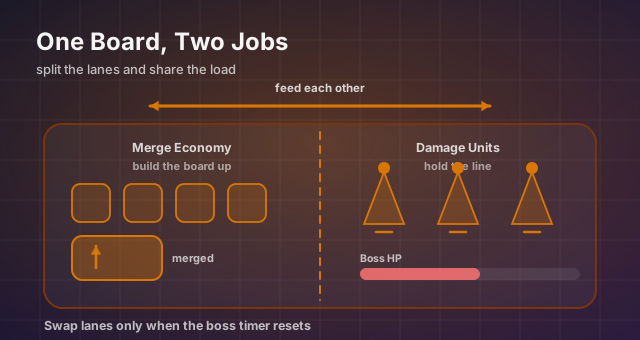
- Split roles before wave one: one player builds economy, the other converts it into damage.
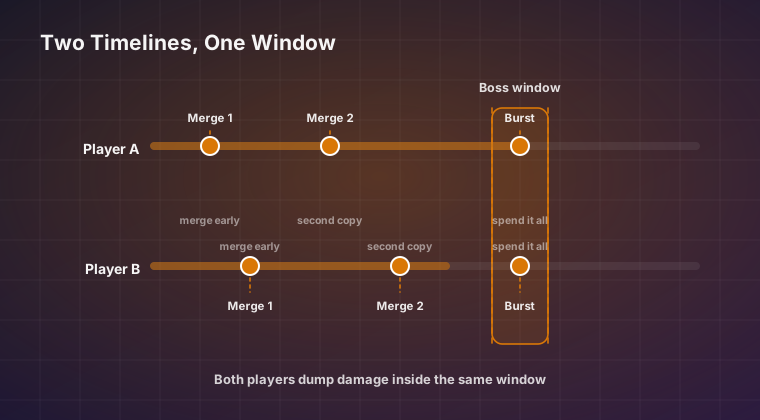
- Sync your merge pushes to the same boss window instead of upgrading on separate clocks.
- Two players building damage is the single most common reason co-op runs collapse mid-game.
Co-op is the only Rush Royale mode where your board is shared but your mana is not, and that mismatch causes almost every failed run. Two players can both play "well" by solo standards and still collapse at the same wave. This guide is about dividing the work so the pair scales instead of competing for the same tiles.
The two roles: economy and conversion
Pick roles in the first ten seconds. One player takes economy and board control: mana support units, cheap filler, and keeping the board mergeable. The other takes conversion: turning that space and income into ranked damage dealers. Neither role is "support" in a passive sense - both are playing the board, just spending on different things.
The reason this split works is that mana income and tile supply are both finite. Two players buying attackers at the same time bid against each other for merges, and neither reaches high rank. One player deliberately under-spending on damage raises the other player's ceiling by more than their own board loses.
Roles are not permanent. Around the mid waves, the economy player usually has surplus income and starts converting too. The rule is sequencing, not identity: economy first, damage second, both players late.
Mana and tiles: the shared constraint
Each player owns a private mana pool but a public tile supply. That means the scarce resource in co-op is not mana, it is empty tiles at the moment a merge is available. A board full of unmatched singles is a board that cannot scale, regardless of how much mana either player holds.
Treat the board like a shared inventory. When your partner has a pair waiting, do not fill the last free tile with a speculative unit. Merge your own pairs first, keep at least two tiles open, and only place new units when you can also merge within a few seconds.
- Never place a unit you cannot pair within one or two waves.
- Leave two free tiles before every boss wave so a reshuffle has somewhere to put things.
- If your mana bar is capped and no merge exists, spend into rank-ups, not new placements.
- Upgrade your partner's mana support before your own filler damage if only one can be funded.
- After a board-disabling boss, both players rebuild economy before either rebuilds damage.
Wave pacing and boss windows
Waves arrive on a fixed rhythm, and bosses interrupt it. The pair that dies is usually the pair that was mid-expansion when the timer flipped - half-finished merges, no banked mana, both players out of tiles. Aligning your expansion cycle to the wave timer is the single biggest co-op skill.
Work in cycles: expand during the quiet stretch right after a boss, then compress before the next one. Compressing means stopping new placements, merging what is on the board, and banking mana. Both players must do it at the same time; one player still expanding while the other banks leaves the board half-prepared, which is worse than both expanding.
Bosses are also the only moment where role asymmetry pays off explicitly. The conversion player should enter the window with a reserve to spend the instant the ability resolves; the economy player should have enough banked to re-establish income if units are disabled or shuffled.
Signals without voice chat
Most co-op pairs never speak, so the board has to carry the message. Placement position is the clearest signal: units placed in a consistent area read as "this is my zone," and merging a partner's leftover single is an unambiguous "I have spare mana, you are behind."
Use three readable behaviours. Bank visibly - stop placing for a few seconds before a boss, which tells your partner a boss window is coming. Merge their orphan - which tells them to stop placing new units and consolidate. And hold a tile - which tells them you are about to drop something that needs a neighbour.
What does not work is spamming placements as encouragement. It reads as pressure, and the usual result is the exact failure you were trying to avoid: both players expanding into a boss.
Common co-op mistakes and their fixes
Nearly every lost run maps to one of a handful of patterns, and they are all fixable without new cards. The table below lists the mistake, what it looks like from inside the match, and the correction to apply next time.
| Mistake | How it looks in the run | Correction |
|---|---|---|
| Both players build damage | Full board, no merges available, no mana to upgrade | Assign one player economy before wave one; damage player merges what appears |
| Expanding into a boss | Timer flips mid-placement, board left half-upgraded | Stop placing a few seconds pre-boss; bank, merge, wait |
| Hoarding mana | Bar sits capped while rank of key units stays low | Spend on merges the moment a pair exists; capped mana is wasted income |
| Ignoring economy rebuild | Survive the boss, then stall two waves later | After any disabling ability, re-establish mana support first |
| Duplicating unit roles | Two copies of the same niche unit, no splash or support | Coordinate deck slots before queueing; cover distinct roles |
| Tile-blocking a partner | Partner's pair cannot be placed anywhere | Keep two tiles free and merge your own singles first |
If the first boss nearly kills you, the run is already decided. Decide together whether to keep investing or accept the floor rewards and requeue with better decks rather than dragging out a doomed run.
Final verdict
Co-op is not a mode where you carry a stranger by playing faster. It is a mode where two players agree on who spends on income and who spends on damage, then compress and expand on the same beat. Pairs that do this with average decks routinely outlast pairs with better cards and no plan.
The practical takeaway is small: choose a role in the first ten seconds, keep two tiles free, stop placing before every boss, and read your partner's board instead of your own. Do those four things and most co-op runs stop ending at the same wave.
Keep reading

Rush Royale Game Modes Explained: PvP, Co-op and Rotating Events
Every queue in Rush Royale side by side: what you actually do in each one, what it pays out, and how often it is worth your time.
Rush Royale Leagues and Ranked Seasons: How Climbing and Resets Work
How league tiers and seasonal resets actually work, when to push rating and when to stop, and why your ceiling is usually a collection-depth problem.
Rush Royale Boss Waves: Timers, Mechanics and Survival Patterns
Why boss waves decide most runs, the preparation that beats them, and how to read the three boss archetypes before they land.