
Version updates
Rush Royale Patch Day: Your First 48 Hours After an Update
Key takeaways
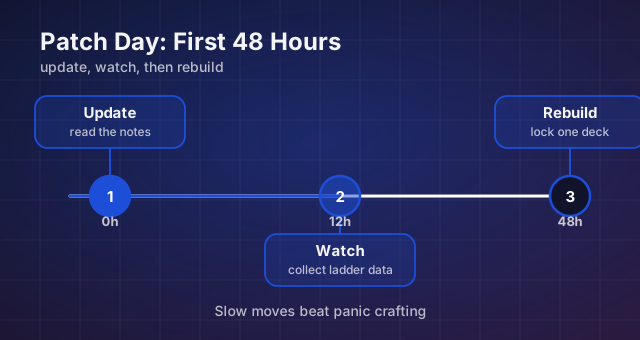
- Update first, read second, rebuild third — never the other way round.
- Read economy and mana changes before damage numbers; that is where real meta shifts start.
- Freeze big spending for a day or two until you know whether the change actually touched your deck.
A major Rush Royale update lands, the timeline fills with hot takes within an hour, and half the player base rebuilds its five-slot deck before lunch. Most of those rebuilds are reversed within three days. This is the 48-hour routine that keeps you out of that group: lock your client, read the notes in the right order, hold your gold, and let your own match data - not someone else's tier screenshot - tell you when a change actually touched your deck.
Update first, react second
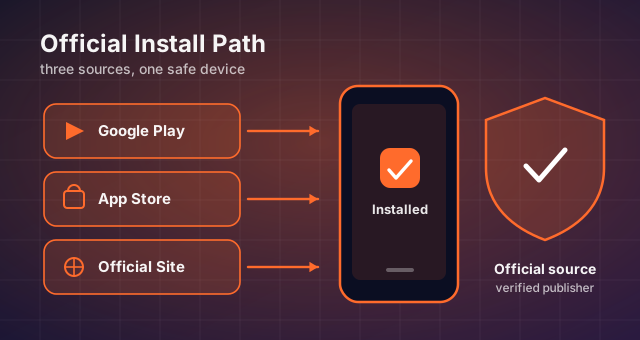
Nothing downstream is valid on a stale client. Pull the update from Google Play or the App Store, or grab it from the official site if you play another way, then fully restart the app and confirm the version string in Settings reads [current version]. If servers are still in maintenance, a successful client update is not the same as a live server - queuing into PvP during that window gives you results you will misattribute later.
Your first read of the notes should be deliberately passive. Note what changed, resist touching your deck, and give the day to breathe. Patch notes describe intent; they do not describe outcomes, and the first builds of a new version are the ones most likely to eat a hotfix within 24 hours. Rebuilding around a number that gets reverted is the single most common wasted spend in this game.
Set a clean baseline before you change anything
Before you play a match, write down what "normal" looks like: your current deck list, the wave you usually reach in co-op, and roughly how long your PvP matches last. Without that baseline you cannot separate a genuine balance shift from ordinary variance, and you will end up trusting the loudest take instead of your own numbers.
The first 48 hours at a glance
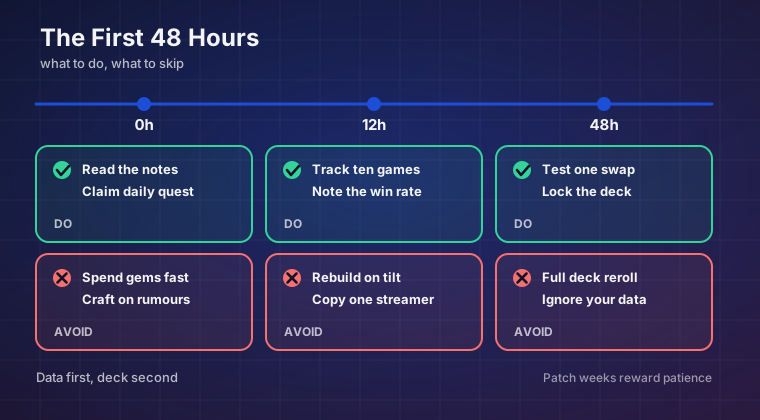
Use the schedule below as a pace rather than a rule. The point is sequencing: information first, low-stakes testing second, data third, and expensive decisions last.
| Time window | Do this | Avoid this |
|---|---|---|
| Hour 0-2 | Update the client, restart, verify the version, read the full notes, screenshot your current deck | Copying a "day one" deck list or spending gold |
| Hour 2-12 | Test on low-stakes modes, check mana generation and wave pacing, watch for a hotfix | Grinding ranked leagues for placement reads |
| Hour 12-24 | Play [N] matches with your unchanged deck and log opponent archetypes, result and end wave | Reordering your deck after a single bad loss |
| Hour 24-48 | Compare your log to the baseline, check which archetypes the meta is converging on | Chasing the highest posted win rate without knowing why it wins |
| Hour 48+ | Make one change, test it, keep it only if the numbers move | Rebuilding several slots at once and guessing which one helped |
Reading notes in the right order
Read economy first. Anything touching mana generation, unit costs or mana support units reshapes every deck in the game, including decks that contain none of the units listed in the notes. A change of [N] mana to your opener compounds through every merge cycle that follows, so it lands long before any damage number becomes relevant.
Numbers second. Damage and attack-speed adjustments to a burst damage dealer or a splash-damage unit look dramatic at [X%], but they only matter to the extent that unit carries your board. Read the direction, read the size, then ask whether the unit is even in your five slots.
Wave and boss pacing third. Co-op and PvP both bend when boss timing shifts, because bosses are the checkpoints that decide whether your board has scaled enough. Save cosmetics, events and pass content for last - they influence what you grind, not how your deck functions.
Percentage changes stack. A small mana increase plus a small damage decrease is not two small changes; it is one compound change, and the combined effect is usually larger than either line suggests.
Is it a real change or a paper one
A listed adjustment only matters if it intersects your win condition. Ask four questions: does it move your mana curve, does it shorten your burst window, does it slow how fast you fill the board, and does it change when you meet the first boss? Four noes means the note is noise for you, regardless of how alarming it reads.
Then test rather than speculate. Run [N] matches with the identical deck and compare three metrics against your baseline: average wave reached in co-op, average PvP match length, and how often you fail the same boss. If all three sit inside your normal variance, nothing about your deck changed and there is no decision to make.
Remember that your opponents moved too. A unit retuned in isolation still shifts the whole pool by changing what everyone faces, so a deck that was never touched can still feel different. That indirect effect is why day-one data is unreliable and why [N] logged matches beat intuition every time.
When to actually change the deck
Change one variable at a time. Your five-slot deck has no spare room for experiments, so swap a single card, play another block of matches, and revert if the metrics do not move. Prefer substitutes within the same role - one splash-damage unit for another, one support piece for another - so you isolate the variable rather than confounding it.
There is also a correct time to do nothing. If only mana support values shifted slightly, if the affected unit is a role you do not run, or if your results are unchanged across a proper sample, leaving the deck alone is the higher-value choice. Patience is a strategy here, not passivity.
Spending freeze and letting the meta settle
Hold your gold for two days. Upgrade paths in Rush Royale are expensive in one direction and unforgiving in the other, and a card that looks mandatory on day one is often merely popular by day three. The cost of waiting is a couple of days of slightly worse upgrades; the cost of rushing is a long rebuild.
Apply the same restraint to gems. Decide on the season or premium track once you have seen what the patch actually rewards and how much you will realistically play - a track you cannot finish is not a discount. Chests and keys are the exception: opening what you already hold costs you nothing in commitment and at worst gives you more material to test with.
Meanwhile, keep sampling. A simple note per match - opponent archetype, result, end wave, one sentence on why it ended - is enough. Act only when the same pattern repeats across [N] games, because one bad session is variance and five converging losses are information.
Even when a change genuinely hurts your deck, waiting 48 hours almost always costs less than rebuilding into the wrong answer. The situation you are protecting against is temporarily weaker play, not permanent loss.
Final verdict
Patch days reward process, not speed. Update cleanly, read the economy lines before the damage lines, freeze your spending, and let your own logged matches decide whether anything about your five slots actually moved. Every bracketed value in this routine - [current version], [N], [X%] - should be filled in from the official notes for the update you are reacting to, never from memory or from a screenshot someone else posted.
The players who climb fastest after an update are rarely the ones who rebuilt first. They are the ones who kept a baseline, changed one card at a time, and spent gold on a decision they had already validated. Do that for two days and the new version stops feeling like a reset and starts feeling like an edge.
Keep reading
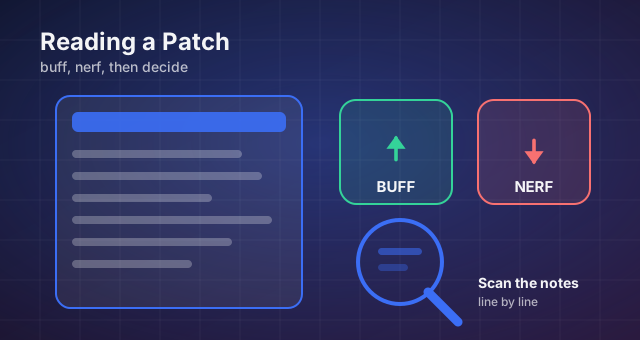
Rush Royale Update Explained: How to Read a Patch and Rebuild Your Deck
A repeatable method for reading Rush Royale patch notes: which changes move the meta, which ones are noise, and how to rebuild a five-slot deck after a balance shift.
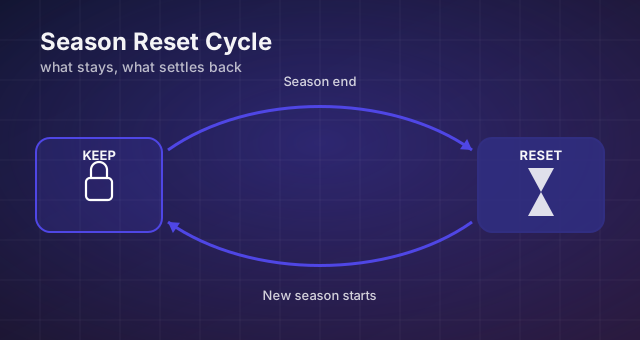
Rush Royale Season Reset: What Carries Over, What Resets and How to Prepare
What usually survives a Rush Royale seasonal flip, what gets settled back, and the checklist worth running in the week before it happens.
Rush Royale APK: Official Version, Requirements and a Safe Install Guide
What the Rush Royale APK actually contains, current Android requirements, how to update cleanly and how to spot a repackaged installer before it costs you your account.