
Guides
10 Rush Royale Mistakes That Cost You Matches (And How to Fix Them)
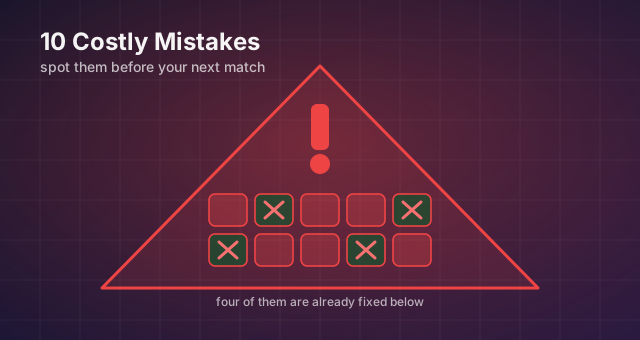
Key takeaways
- Filling the whole board early removes the tiles you need for merges.
- Neglecting core card levels caps your damage harder than any deck change fixes it.
- Ignoring boss timers is the fastest way to lose a run you were actually winning.
Most lost matches in Rush Royale are not lost to a stronger card collection, they are lost to habits: a board filled too early, mana spent on reflex, upgrades scattered across five decks. Here are ten mistakes that reliably cost matches, what they actually look like mid-game, and the concrete fix for each one.
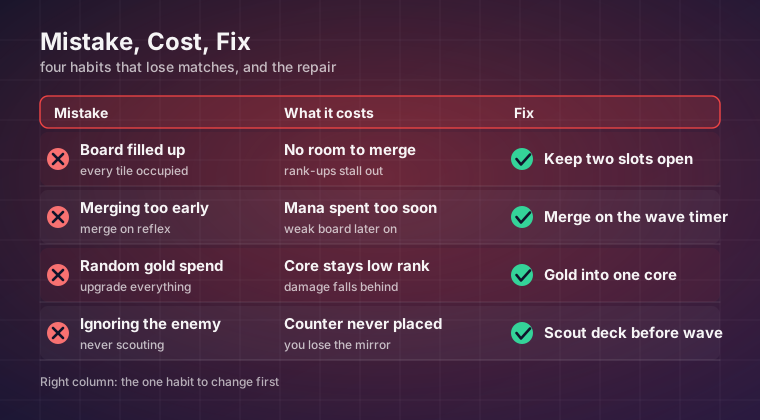
Mistake 1: Filling the board instead of merging
A full board feels like progress and is usually the opposite. Every tile held by a low-rank unit is a tile that cannot receive a merge, so your board stops growing while the waves keep scaling.
Treat empty tiles as a resource. Place only what the wave requires, keep [X] tiles free near your strongest unit, and merge duplicates before adding bodies. One rule to remember: merge first, place second.
Mistake 2: Spending mana the moment you have it
Reflex spending is the most common mana error. Mana has two uses - building board power now and holding a reserve for the wave that actually threatens you - and players who spend on reflex always arrive at the boss with an empty bar and no answer.
Hold a reserve instead. Bank to roughly [X] mana before bosses, spend down during the wave, then rebuild. The habit matters more than the number: if your bar sits at zero every time a boss spawns, your deck is fine and your pacing is not.
Mistake 3: Running a deck with no mana economy
Five damage cards look intimidating and lose to any deck that can afford to keep placing units. Without a mana support unit your board plateaus after the opening, and every later wave is played at a mana deficit you never recover from.
Reserve one slot for economy and one for utility. That leaves three damage slots, which is enough for a splash unit, a single-target dealer, and a flex card. Diagnose the problem by watching your bar, not your damage meter.
- Bar empty by wave three: your curve is too expensive, add a cheap unit you can spam for pairs.
- Bar permanently full: you are not converting mana into board power, your units cost too little or you are waiting for perfect merges.
- Bar healthy but board weak: the problem is placement and merge priority, not economy.
Mistake 4: Upgrading everything a little
Spreading gold evenly across every card feels safe and produces a collection that is mediocre in every archetype. Upgrades are what make a unit reach a meaningful rank in a real match, and a deck of half-leveled cards loses to a focused deck at every league threshold.
Pick one archetype, then upgrade its five cards - and the support unit first. Everything else waits. When that deck stops gaining ranks from upgrades, start the second one rather than topping up the first.
Mistake 5: Having no answer for boss waves
Clearing trash waves is not the win condition; killing bosses is. Decks built entirely around splash damage stall out at the first large health pool, chip it down slowly, and lose to leakage rather than to a bad board.
Every deck needs one reliable single-target damage dealer and a plan for where it sits. If your boss fights consistently take more than [X] seconds, that is a deck problem, not a mechanics problem.
Mistake 6: Copying a deck you cannot actually run
Copied lists fail because the copy is missing its engine. A deck built around one high-rank payoff card does nothing at rank one, and a deck that assumes a specific support unit collapses without it.
Copy the shape, not the list. Identify what the deck is trying to do - ramp, control, burst - then fill each job with the best card you own that does it. If you cannot name your win condition before the match starts, the deck is not finished.
Mistake 7: Reviewing losses as bad luck
Losses are data: players who blame draw order repeat the same defeat for weeks, while players who ask "what killed me" improve in days - a boss, a dense wave, or an empty mana bar.
Each answer maps to one fix: bosses mean single-target damage, dense waves mean splash, an empty bar means economy.
Mistake 8: Using one deck for every mode
PvP, co-op, clan wars and rotating daily events ask different questions. A PvP deck tuned to survive disruption is often wrong for co-op, where you share one board with a partner and duplicate jobs waste tiles.
In co-op, coordinate before the match: one player brings boss damage, the other brings wave clear and economy. In events, read the modifier first - a change to wave composition or mana rules quietly invalidates cards you relied on yesterday.
Mistake 9: Leaving free progression on the table
Accounts stall because resources are never collected, not because they are scarce. Chests sit unopened, keys expire, daily events go unplayed, and the season pass track is left half finished at reset.
Build a five-minute routine: open chests, spend keys before they cap, clear the daily event, and check the season pass progress before you queue for leagues. The gems and gold from that routine fund the upgrades in mistake 4, which is why it compounds.
Mistake 10: Believing shortcut offers
Every competitive game attracts offers promising currency you have not earned, or a lighter unofficial build. They are not shortcuts: unofficial installers break the terms of service, risk a permanent ban on an account you have spent months building, and are one of the most common ways to install malware on a phone.
There is no gameplay benefit to chase either. Progression comes from merges, mana pacing and deck planning, and none of those are solved by a different install file. Get the game only from Google Play, the App Store, or the official site.
Never install an unofficial build or enter account details on a site offering currency, no matter how official it looks. Use Google Play, the App Store, or the official website only, and treat any offer of currency you have not earned as a phishing attempt.
Final verdict
Almost every mistake on this list is the same mistake viewed from a different angle: short-term comfort chosen over long-term board power. Filling the board, spending mana on reflex, and spreading upgrades all feel good in the moment and all lose the wave that matters.
Pick two fixes and apply them for a week - merging before placing, and holding a mana reserve before bosses, are the highest value pair. The improvement shows up in wins long before it shows up in your collection.
Keep reading
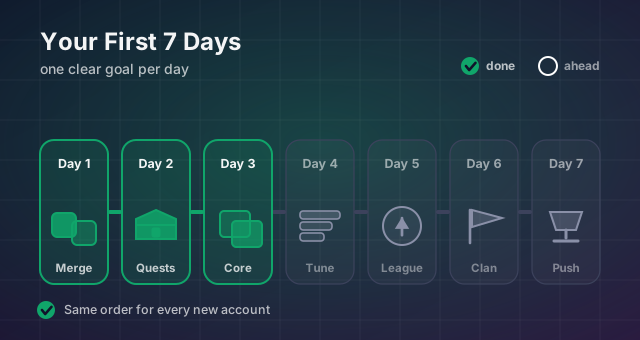
Rush Royale for Beginners: A Practical First 7 Days Roadmap
The three decisions that decide whether a new Rush Royale account snowballs: what you merge, what you spend, and which modes you queue.
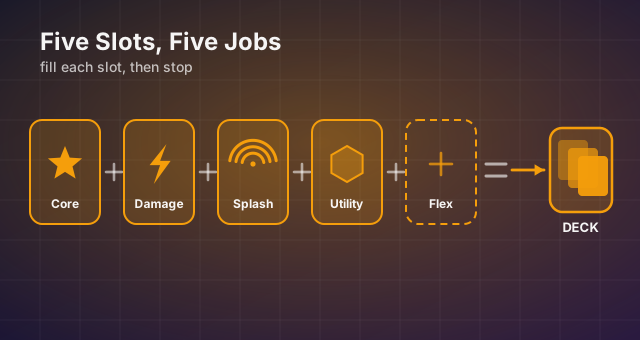
Rush Royale Deck Building: How to Build Five-Slot Decks That Win
Slot roles, merge maths and three archetypes that hold up in ranked — plus how to tune a single slot instead of rebuilding everything after a loss.
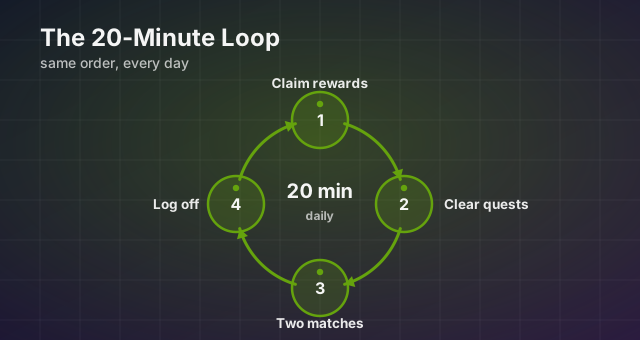
Rush Royale Daily Routine: A 20-Minute Loop That Compounds
A repeatable daily, weekly and seasonal checklist that clears every renewable reward without eating your evening.